
Science Friction
Suspended
-
Joined
-
Last visited
Everything posted by Science Friction
-
Sh2-68 is a feint planetary nebula... WITH TWO CREEPY LITTLE BEADY EYES!!!! [ATTACH]64392[/ATTACH]
-
The Phantom Streak Nebula, more prosaically known as NGC 6741, is a planetary nebula located about 7000 light-years away in the constellation of Aquila. Its central star, a white dwarf, has released its former atmosphere into space, where it glows eerily when excited by the dwarf's UV light. [ATTACH]64391[/ATTACH]
-
The Skull Nebula (NGC 246) in Cetus mimics the shape of a human skull with large purple eye sockets and an open mouth. [ATTACH]64390[/ATTACH]
-
One of the more "striking" faces in the night sky. This is the Witch Head Nebula (IC 2118), a reflection nebula illuminated by the star Rigel. [ATTACH]64389[/ATTACH]
-
The Ghost of the Moon Nebula (NGC 6781) in Aquila appears to hover mysteriously against the constellation's background stars. [ATTACH=CONFIG]64387[/ATTACH]
-
I'll show you some of my favorite "spooky" nebulae: Does this not look like a scene out of a Tim Burton movie? This is the Ghost Nebula. It is one of the most evocative in the sky. It's part of a much larger molecular cloud in Cepheus and shines by the reflected light of embedded stars. LOVE this nebula!!! Happy Halloween astronomy enthusiasts.

-
It’s thought that the early forbearer of Halloween – Samhain – happened on the night that the Pleiades star cluster culminated at midnight. That is, the Pleiades climbed to its highest point in the sky at midnight on or near the same date as this cross-quarter day. The midnight culmination of the Pleiades cluster now occurs on November 21, but back in the 11th and 12th century, Samhain and the midnight the Pleiades event would have taken place on or near the same date. At that time, when the Julian calendar was in use, the cross-quarter day and the midnight culmination of the Pleiades fell – amazingly enough – on or near October 31. If the Gregorian calendar had been in use back then, the cross-quarter day celebration would have been held on November 7. The Pleiades cluster, also known as the Seven Sisters:

-
Halloween – short for All Hallows’ Eve – is an astronomical holiday. Sure, it’s the modern-day descendant from Samhain, a sacred festival of the ancient Celts and Druids in the British Isles. But it’s also a cross-quarter day, which is probably why Samhain occurred when it did. Early people were keen observers of the sky. A cross-quarter day is a day more or less midway between an equinox (when the sun sets due west) and a solstice (when the sun sets at its most northern or southern point on the horizon). Halloween – October 31 – is approximately midway point between the autumn equinox and winter solstice, for us in the Northern Hemisphere. The true cross-quarter day is actually November 7, a discrepancy of a week. In other words, in traditional astronomy, there are eight major seasonal subdivisions of every year. They include the March and September equinoxes, the June and December solstices, and the intervening four cross-quarter days. In modern times, the four cross-quarter days are often called Groundhog Day (February 2), May Day (May 1), Lammas (August 1) and Halloween (October 31). For us in the Northern Hemisphere, Halloween is the darkest of the cross-quarter days, coming at a time of year when the days are growing shorter. Early people once said that the spirits of the dead wander from sunset until midnight around this cross-quarter day. After midnight , on November 1, which we now call All Saints’ Day , the ghosts are said to go back to rest.
-
I think I spotted Watusi... Was that his picture hanging on the wall ???

-
No, it's not the Fourth of July and it's not crazy Kim of NK shooting off his rockets. This was last weekend over Wulan Hada volcano in Inner Mongolia, China. Over a dozen meteors from the Orionids Meteor Shower were caught in successively added exposures. The multiple meteor streaks are all connected to a single small region in the sky called the radiant, visible above and just to the left of the belt of Orion. Comet Halley is responsible for the Orionids shower.

-
Good question. Little Epsilon(the star that really seemed to peeve Twain off) is on the opposite side of what you would observe if you looked up at the constellation. (See my picture above). I'm guessing there may be some religious significance. If you were positioned somewhere well beyond those stars and looking down at the Earth(maybe like God's perspective, perhaps), that's the way the Southern Cross would look. First time I've really thought that deeply about the Brazilian flag before.
-
Here you can see the four main stars of the Southern Cross. Can you spot the little "intruder," Epsilon Crucis, the little star that Twain said to ignore?

-
Apparently Mark Twain was a bit underwhelmed at his first viewing of the Southern Cross. Twain wrote of the Southern Cross, viewed for the first time and reported in his book, Following the Equator: "We saw the Cross to-night, and it is not large. Not large, and not strikingly bright. But it was low down toward the horizon, and it may improve when it gets up higher in the sky. It is ingeniously named, for it looks just as a cross would look if it looked like something else. But that description does not describe; it is too vague, too general, too indefinite. It does after a fashion suggest a cross — a cross that is out of repair – or out of drawing; not correctly shaped. It is long, with a short cross-bar, and the cross-bar is canted out of the straight line. It consists of four large stars and one little one. The little one is out of line and further damages the shape. It should have been placed at the intersection of the stem and the cross-bar. If you do not draw an imaginary line from star to star it does not suggest a cross – nor anything in particular. One must ignore the little star, and leave it out of the combination – it confuses everything. If you leave it out, then you can make out of the four stars a sort of cross – out of true; or a sort of kite – out of true; or a sort of coffin-out of true." Despite Twain’s reluctance to be impressed, many love the Southern Cross, and today this constellation is used as a symbol on the flags of several nations in the southern hemisphere. As far as I'm concerned , whenever I view the Southern Cross for the first time , I'd say I'll feel more like Stephen Stills than Samuel Clemons. I'll understand why I came that way.
-
"When you see the Southern Cross for the first time, you understand now why you came this way..." CS&N One thing on my bucket list is to view the Southern Cross. If I travel to the Southern Hemisphere to view the solar eclipse in 2019, I'll have my chance. The Southern Cross is one of the best known asterisms in the night sky, and the most familiar star pattern in the southern hemisphere.Composed of five stars forming the shape of a cross, it is the most distinctive feature of the constellation Crux, the smallest constellation in the sky. The Southern Cross is notable for containing two bright stars, Acrux and Gacrux, which point the way to the Southern Celestial Pole. The asterism is one of the easiest to identify in the sky and it has significance in a number of cultures in the southern latitudes. As the Southern Cross dominates Crux constellation, it is often confused for the constellation itself, which contains more than five stars. The stars that form the cross asterism are just the brightest ones located in the constellation. The stars of the Southern Cross – Alpha, Beta, Gamma, Delta, and Epsilon Crucis – form an asterism that really looks more like a kite than a cross. Two of the brightest stars that form the cross, Alpha Crucis(Acrux) and Beta Crucis(also known as Becrux or Mimosa), are among the brightest stars in the sky(Acrux is 13th brightest and Mimosa , 19th)and easily visible from the southern hemisphere. Both Alpha Crucis and Beta Crucis(Mimosa) are actually binary star systems. Mimosa is about 280 LY from our solar system and has about the same brightness as Deneb, the brightest star in the Cygnus constellation. Delta Crucis is a hot, massive blue-white subgiant star currently in the process of becoming a red giant.It has a mass 8.9 times that of the Sun and is 10,000 more luminous. Like Mimosa, Delta Crucis is believed to be a Beta Cephei-type variable. Delta is about 345 LY from our solar system. Gamma Crucis, or Gacrux, is approximately 88.6 light years distant. It is the nearest red giant star to the Sun. Gacrux is the third brightest star of the Southern Cross, after Alpha and Beta Crucis. Sometimes called Rubidea because of its ruby-like color, Gacrux is only about 30 percent more massive than the Sun, but has 84 times the Sun’s radius and is 1,500 times more luminous. The star is classified as a semi-regular variable (SRV) with multiple periods. Epsilon Crucis is an orange giant lying at a distance of 228 LY from the solar system. Also known as Intrometida, or “the intrusive one” in Portuguese, the star has 1.42 times the Sun’s mass and a radius 32.9 times solar. The Southern Cross is located near the larger constellation Centaurus, which surrounds it on three sides. To find the Southern Cross, first look for the two very bright stars nearby, Alpha and Beta Centauri. Following a line from Alpha to Beta Centauri will take you near Gamma Crucis, the top star in the cross asterism. To see the Southern Cross, one must be in the southern hemisphere, or at least as far south as 25°N, where the asterism is visible just above the southern horizon. In tropical latitudes, the stars can be seen from April to June. One little factoid that might interest you - the Southern cross could be seen in the Northern Hemisphere, including most of North America , 5,000 years ago. The Southern Cross should not be confused with the so-called False Cross, formed by four other bright stars in the vicinity. The X-shaped False Cross bears a slight resemblance to the Southern Cross and is oriented in approximately the same way, but the four stars are located a bit farther to the north, and they do not point to the Southern Celestial Pole.
-
What's that.... A Hole in the Moon ??? Could humans live beneath the surface of the Moon? This intriguing possibility was bolstered in 2009 when Japan's Moon-orbiting SELENE spacecraft imaged a curious hole beneath the Marius Hills region on the Moon, possibly a skylight to an underground lava tube. Follow-up observations by NASA's Lunar Reconnaissance Orbiter (LRO) indicated that the Marius Hills Hole (MHH) visually extends down nearly 100 meters and is several hundred meters wide. Most recently, ground penetrating radar data from SELENE has been re-analyzed to reveal a series of intriguing second echoes -- indicators that the extensive lava tubes exist under Marius Hills might extend down even kilometers and be large enough to house cities. Such tubes could shelter a future Moon colony from large temperature swings, micro-meteor impacts, and harmful solar radiation. Potentially, underground lava tubes might even be sealed to contain breathable air. These lava tubes likely formed when lunar volcanos were active billions of years ago. Pictured below, the surface of Marius Hills region was captured in the 1960s by NASA's Lunar Orbiter 2 mission, while an inset image of the MHH is shown from NASA's continuing LRO. Several volcanic domes are visible, while Marius Crater is visible on the upper right.

-
Hounds jump out to a 22-0 lead and win another flagfest at Campbell Field. Game never really in doubt after the Hounds put it to bed early. KC has some nice-looking athletes on offense.
-
Final
-
Just wanted to remind all of my BGP astronomy friends that tomorrow evening is International Observe the Moon Night. So, if you are fortunate enough to have some clear skies, get your binoculars or telescope and go observe our celestial neighbor. Sounds like we may have clouds to deal with here in the Bluegrass. International Observe the Moon Night (InOMN) is an annual worldwide public event that encourages observation, appreciation, and understanding of our Moon and its connection to NASA planetary science and exploration, as well as the cultural and personal connections we all have with Earth's nearest neighbor. Everyone on Earth is invited to join the celebration by hosting or attending an InOMN event — and uniting on one day each year to look at and learn about the Moon together. The phase of tomorrow evening's moon--- waxing gibbous, with about 56% illumination. Should look something like this:

-
Did you go to the game? No. Corbin sleepwalked. Casey played hard and seemed to want it more for three quarters. I give them credit for that. They have done a tremendous job at Casey County. Refs, for whatever reason, wanted to play flag football all night. No flow . No energy. At the start of the fourth Corbin decided to hit the gas. Could have won by seven scores if they had started playing out of the halftime break.
-
A big thanks goes out to everyone who reads this thread regularly. Just surpassed 10,000 visits. Maybe that will be 100,000 by the time the eclipse comes around in 2024. Keep posting away !!! I love learning about our incredible universe!!!
-
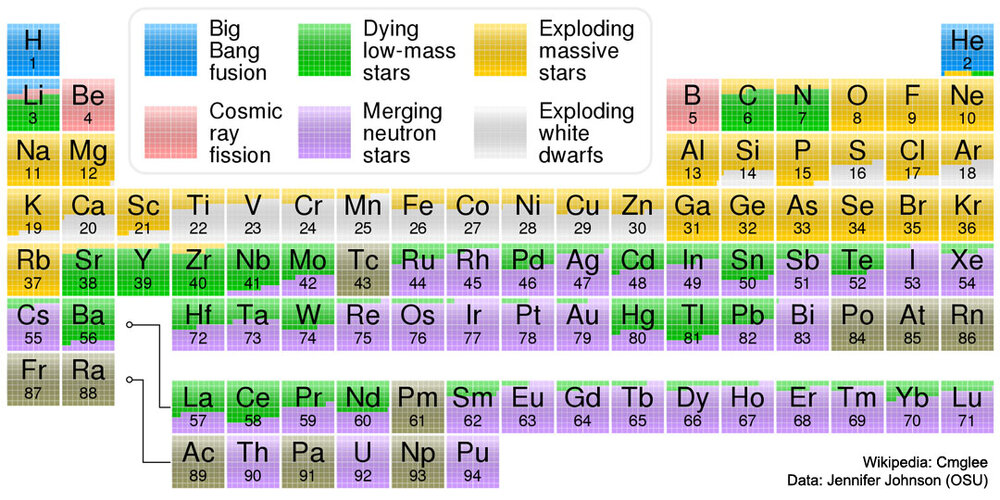
You and I , all of us, even Mt.Ref ... We are all made of "star stuff" ... This is illustrated in the special color-coded periodic table below, which gives humanity's best educated guess as to the nuclear origin of all known elements. The hydrogen in your body, present in every molecule of water, came from the Big Bang. There are no other appreciable sources of hydrogen in the universe. The carbon in your body was made by nuclear fusion in the interior of stars, as was the oxygen. Much of the iron in your body was made during supernovas of stars that occurred long ago and far away. The gold in your jewelry was likely made from neutron stars during collisions that may have been visible as short-duration gamma-ray bursts or gravitational wave events. Elements like phosphorus and copper are present in our bodies in only small amounts but are essential to the functioning of all known life.
-
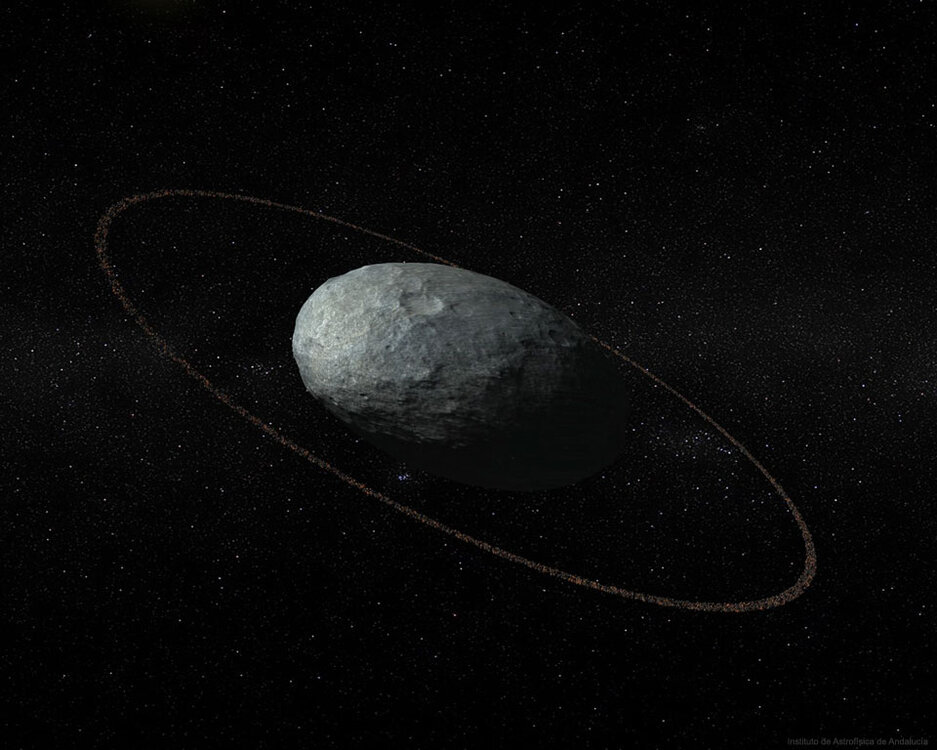
Haumea, Haumea... Wherefore Art Thou, Haumea??? As I mentioned in a previous post , there are currently five AIU- designated dwarf planets. TB&G and I were talking the other day about the unusual dwarf planet, Haumea. Haumea, one of the strangest objects of the outer Solar System, has recently been discovered to have a ring. Haumea's oblong shape makes it quite unusual. Along one direction, Haumea is significantly longer than Pluto, while in another direction Haumea has an extent very similar to Pluto, while in the third direction is much smaller. Haumea's orbit sometimes brings it closer to the Sun than Pluto, but usually Haumea is further away. In the image below, an artist visualizes Haumea as a cratered ellipsoid surrounded by a uniform ring. Originally discovered in 2003 and given the temporary designation of 2003 EL61, Haumea was renamed in 2008 by the IAU for a Hawaiian goddess. Besides the ring discovered this year, Haumea has two small moons discovered in 2005, named Hi'iaka and Namaka for daughters of the goddess.
-
Hounds won't be able to sleepwalk in this one like last week.
-
I hate to see the Jacket program like this. Back in the seventies and eighties, they were one of the best programs around. Loved the old Corbin-M'Boro rivalry. I'm rooting for a M'Boro revival.
-
Don't know what I would do with you and my space weather guy, Bluegrasscard. You folks add a lot to this thread. Thank you, as always.