
Science Friction
Suspended
-
Joined
-
Last visited
Everything posted by Science Friction
-
I would not be surprised to see Boyle win the whole darn thing. They may be playing the best ball of anyone right now. I've had them at #2 for three weeks. They may be claiming #1 before long.
-
Does Michio Kaku know physics?
-
The one that has the shape of a triaxial ellipsoid!!!
-
Corrected that for you. Corbin CAN be either of those teams; however, they can't expect to just sleepwalk through a big part of the game and then steamroll the competition whenever they're ready. I still say: 1. Belfry 2. Boyle 3. Corbin Any of those three can win it all.
-
Hounds, for whatever reason sleepwalked through three quarters. Flags thrown all night long. Affected the flow. Officials apparently thought the fans paid to see them throw handkerchiefs. At the start of the fourth, it seemed like the home team said, "let's put this one to bed." And they proceeded to do just that. Dangerous modus operandi this time of the year, though.
-
IAU-recognized Dwarf planets: 1. Ceres – discovered on January 1, 1801, 45 years before Neptune. Considered a planet for half a century before reclassification as an asteroid. Accepted as a dwarf planet by the IAU on September 13, 2006. 2. Pluto – discovered on February 18, 1930. Classified as a planet for 76 years. Reclassified as a dwarf planet by the IAU on August 24, 2006. 3. Haumea – discovered on December 28, 2004. Accepted by the IAU as a dwarf planet on September 17, 2008. 4. Makemake – discovered on March 31, 2005. Accepted by the IAU as a dwarf planet on July 11, 2008. 5. Eris – discovered on January 5, 2005. Called the "tenth planet" in media reports. Accepted by the IAU as a dwarf planet on September 13, 2006. How many of the five did you know? If you knew more than two of them that's pretty darn good.
-
There have been five dwarf planets recognized by the IAU(International Astronomical Union) since 2008. One of these five was demoted from planet status several years ago. I expect most everyone knows that one. On the other hand, you probably need to be an astronomy enthusiast to name the other four. How many of the five IAU-recognized dwarf planets can you name??? Btw, there are at least six more that are almost certainly going to be officially recognized sometime in the near future and probably dozens, if not hundreds more, later on.
-
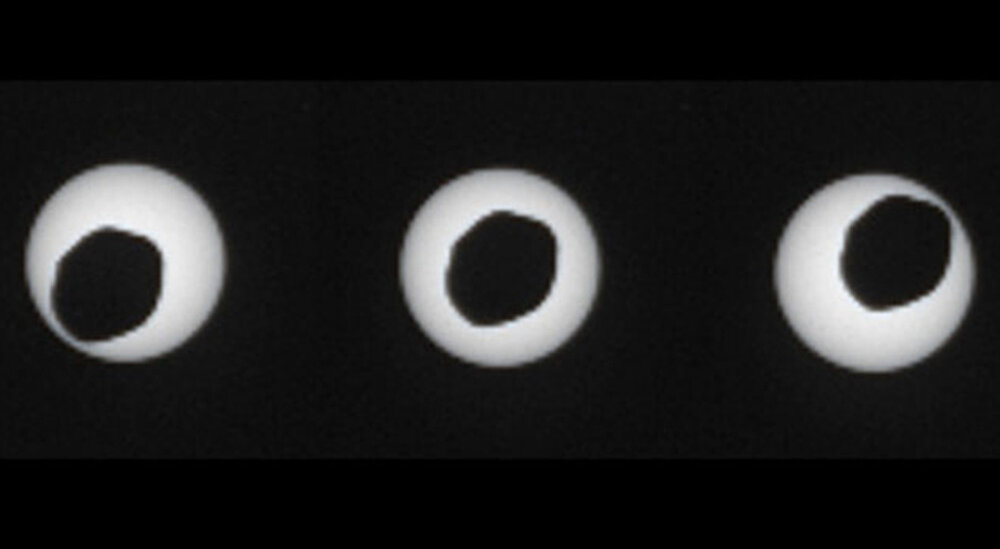
Correction: Typo in the above post. Phobos' annular eclipse of the sun was photographed by Curiosity in 2013, not 2003.
-
You're right, had they not turned the ball over last year, that game would have been very close. They moved the ball well on the Hounds last year.
-
Phobos, Mars' largest moon, is seen eclipsing the sun back in 2003. The images were captured by NASA's Mars rover, Curiosity. Phobos was nearly overhead when its silhouette was captured crossing the Sun. This is as close to a total eclipse as is possible from Mars. You may be wondering how a tiny little moon like Phobos that is only about 14 miles in diameter can cover up such a good size chunk of the sun. Well, Phobos orbits Mars at a distance of only 3,700 miles, compared to the 239,000 mile Earth-Moon distance. In fact, Phobos orbits closer to its primary body than any other planetary moon. It is indeed so close that it orbits Mars much faster than Mars rotates, and completes an orbit in just 7 hours and 39 minutes. As a result, from the surface of Mars it appears to rise in the west, move across the sky in 4 hours and 15 minutes or less, and set in the east, twice each Martian day. And now you know the rest of the story...
-
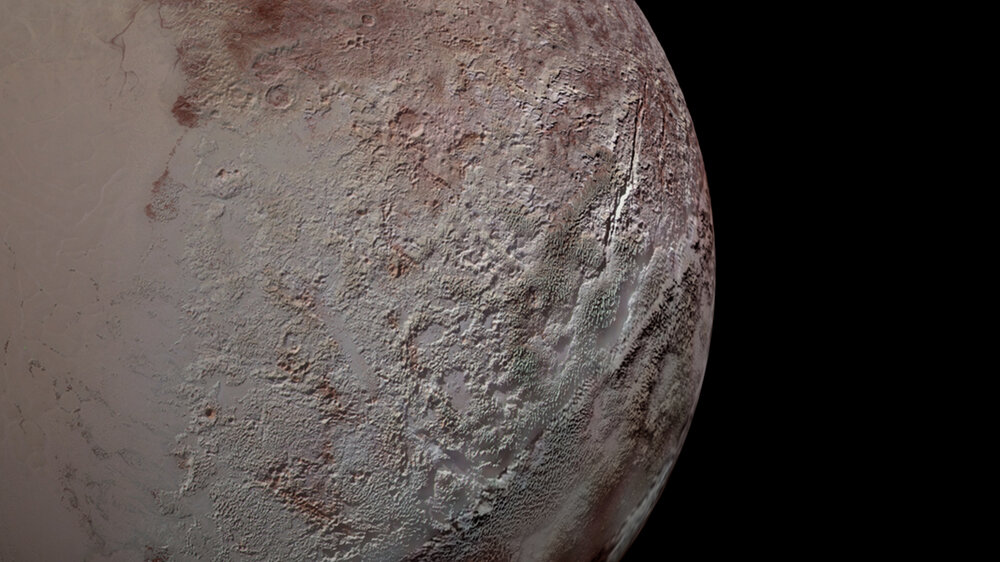
Pluto needs to bathe in some Blue Star Ointment ... Looks like the dwarf planet has a severe case of eczema or psoriasis. Imaged during the New Horizons spacecraft flyby in July 2015, Pluto's bladed terrain is captured in this close-up of the distant world. The bizarre texture belongs to fields of skyscraper-sized, jagged landforms made almost entirely of methane ice, found at extreme altitudes near Pluto's equator. Casting dramatic shadows, the tall, knife-like ridges seem to have been formed by sublimation. By that process, condensed methane ice turns directly to methane gas without passing through a liquid phase during Pluto's warmer geological periods. On planet Earth, sublimation can also produce standing fields of knife-like ice sheets, found along the high plateau of the Andes mountain range. Known as penitentes, those bladed structures are made of water ice and at most a few meters tall.
 Any ideas???Casey has done a great job. I remember seasons where they had 0 wins. Now they are a force to be reckoned with. Great job, Casey County!!!Owl, no one took me up on my invitation to discuss sex in space. Would you like to be the virgin poster to take up this topic? I am fascinated by the idea of space travel in the future. Obviously, we will be spending more and more time in space and possibly living in space for long periods of time. Do you think the act has already been consummated off of planet Earth? NASA says no but, of course, they would say that. I can't imagine that they wouldn't want to test lovemaking in microgravity. This has long-term ramifications. Has it happened? Can it happen? Does the continuation of the our species depend upon us proving the human Big Bang Theory can be successfully carried out? What are the negative effects of microgravity on the human body that could make the act difficult ? Thoughts anyone?Hint: Northern KY city by the same name...These three images were taken 3 seconds apart back in 2013. Any ideas what was going on here?
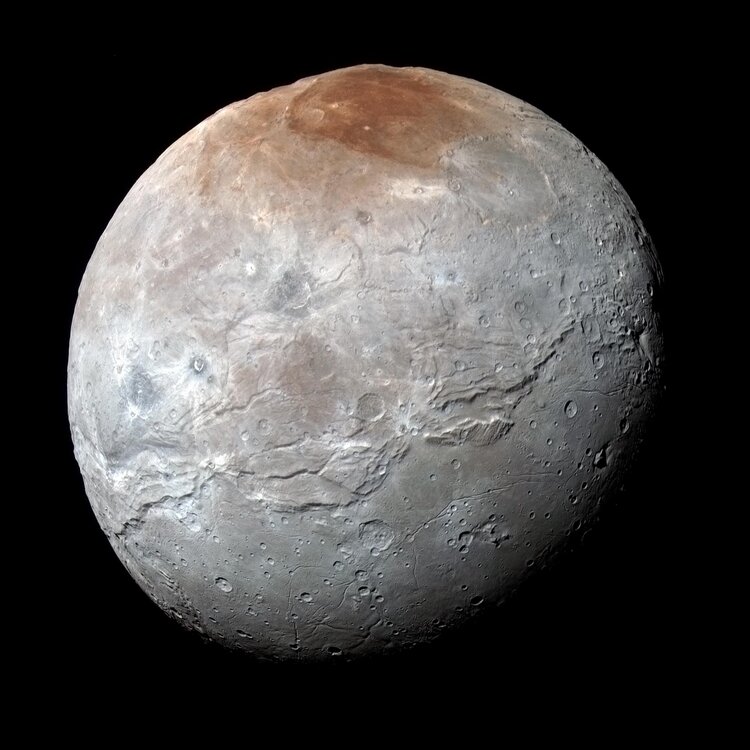
 I know!!! I know!!! In fact, check out post #420 from Saturday, but not before trying to answer TB@G's question.Calpreps seems to be very good.Looks like TB&G and Renuncible Owl(one of my fav. BGP names, btw) had successful quiz answers. I hope all of you enjoyed the quiz about moons of the solar system. I will post the answers below if you want to check your answers. Answers: 1. Io 2. Ganymede 3. Titan 4. Charon Bonus: Io Enceladus TritonI have a bonus question for you folks. Has anyone gotten all four of the previous questions correct? I'm sure TB&G has. Here's the bonus. Besides Earth, there are only three worlds in our solar system that are known to still have active volcanoes on its surface. Can you name all three? 1. This moon, which I've already mentioned in a previous question, is the most volcanically active world in our solar system. It's the innermost moon of a big planet. Name it. ________ 2. This is a moon of a ringed- world. Cassini took a bunch of pictures of this moon and its geysers. Is this world spewing out the ingredients for life? Maybe. Name this moon. _______ 3. This is the largest moon of an outer planet. Unlike our Moon, which is slowly inching away from Earth, this body is being drawn closer to its parent planet. Someday in the distant future, this moon will get too close and will be ripped apart by tidal forces. NWO's forecast for this moon: "Colder than a fart in a dead Eskimo." Better take a rather hefty coat and some long johns if you plan on visiting this place. The average surface temp is a rather chilly -391 degrees Fahrenheit !!! Name this moon. ________delete4. At half the diameter and 1/8 the mass of the dwarf planet it orbits, this moon is the largest satellite in the solar system relative to its parent "planet." This body and its partner- in -orbit make up the solar system's only double dwarf planetary system. The moon and its celestial partner always face each other due to mutual tidal locking. This moon is named after the old geezer in Greek mythology who ferried the souls of the dead to the river Styx. Name this moon. ___________ If you think you know it, indicate with a "Like" below. Look at those fault lines and canyons on that world? And you thought the Grand Canyon was huge?
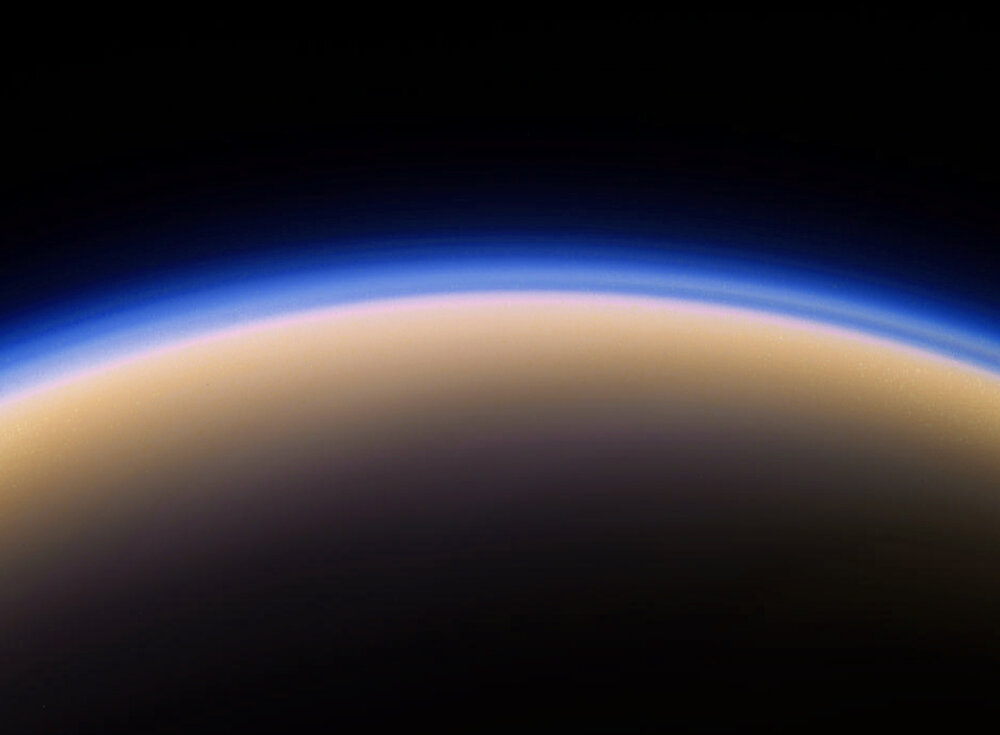
 3. There is one almost incomprehensible fact about this moon. It has an atmosphere that is so thick that it is 50% LARGER than Earth's atmosphere. Think about that!!! Only nine other moons in the solar system are known to even have at atmosphere at all, and most all of those are so thin as to barely register as a trace. This moon's atmosphere is 98.4% nitrogen and rivers of methane flow on it's surface in a greater capacity than beer flowing on the weekends at a University of Kentucky Frat house. NWO's forecast for this moon tomorrow--- "Cloudy, hazy, and cold , just like every other damned day ! " Can you name this moon? _________ If so, indicate with a "Like" or a post below.
 2. Also one of the four Galilean moons, this body is the ninth-largest object in the solar system. At nearly 3,300 miles in diameter, this moon is larger than Mercury and Pluto and is two-thirds the size of Mars. It would easily be classified as a planet if it orbited the Sun rather than Jupiter. In 2030, this moon will be a focal point of a European Space Agency mission. It is thought to have a salty ocean beneath its icy surface. Can you name this moon? ____________ If so, indicate with a "Like" or a post below.