
Science Friction
Suspended
-
Joined
-
Last visited
Everything posted by Science Friction
-
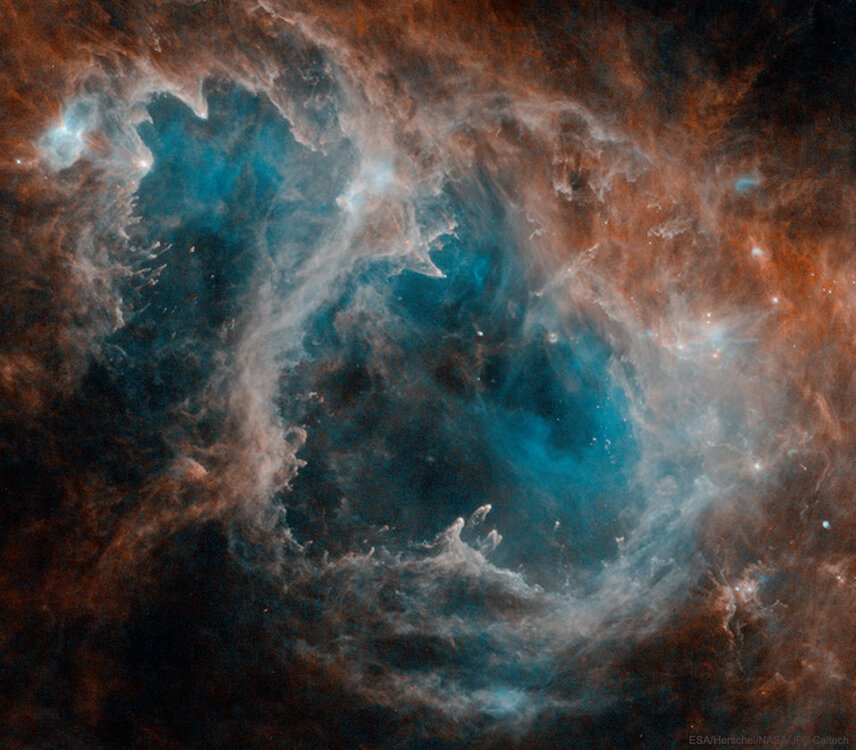
The Heart & Soul of Our Galaxy ...??? The Soul Nebula which I referenced above is often imaged with its celestial neighbor, the Heart Nebula. Get it... Heart & Soul. The Heart and Soul are two bright emission nebulas located about 6,000 light-years from Earth in the constellation Cassiopeia . The Heart and Soul nebulae form a vast star-forming complex that makes up part of the Perseus spiral arm of our Milky Way galaxy. The nebula to the right in the picture is the Heart Nebula, so-named because of its resemblance to the human heart. To the left is the Soul Nebula, also called the Embryo Nebula. The Perseus arm lies further from the center of the Milky Way than the arm that contains our sun. The Heart and Soul nebulae stretch out nearly 580 light-years across, covering a small portion of the diameter of the Milky Way, which is roughly 100,000 light-years across. The two nebulae are both massive star-making factories, marked by giant bubbles that were blown into surrounding dust by radiation and winds from the stars. In the cooler and dustier crevices of these clouds, the gas and dust are just beginning to collect into new stars. Enjoy!!!

-
Beautifully-detailed image of the Soul Nebula, compliments of the Herschel Space Observatory.
-
Agree. Taylor has to be on the list. He had a monster summer against excellent competition.
-
My heart says Jumpers; my head says Ads. I'd say my heart will take the loss. So typical. Hard to see the Jumpers being able to outscore Danville.
-
One of these days..... Just a matter of time before something big hits us. NWO posts Winter Storm Warnings on here; you can be our guy to post Doomsday Warning!
-
Did some Sun-viewing(chromosphere and photosphere) with telescope Saturday while in TN. Observed some sunspot activity. Saw a nice program at the planetarium on spectral analysis of deep sky objects.
-
LEGEND!!!
-
Those neutron stars are indeed something else. It's nearly impossible for our minds to fathom something that dense. Since you liked those tidbits about these strange "Stars Gone Bad," let me add a couple more intriguing facts. While it's true that these stars have a solid surface, standing on the surface of one would be quite the challenge. And that's quite an understatement. A neutron star is about 100 times hotter than the Sun, and the gravity is so incredibly strong that you would expend the same amount of energy climbing a one centimeter bump on a neutron star as you would scaling Mt. Everest on Earth!!!! Combining a large mass and a relatively tiny size means incredible density(density=mass/volume). Try 400 trillion times as dense as water!!! We can't make anything that dense. In fact, that's about as dense as the nucleus of an atom. A neutron star is essentially an atomic nucleus the size of a city. The gravity is enough to squeeze atoms until electrons combine with protons to make neutrons. How strong is the gravitational pull of a neutron star? VERY strong...The gravity is enough to squeeze atoms until electrons combine with protons to make neutrons. And that's just the garden variety neutron star. Another type has an even more exceptional magnetic field. There have been 21 neutron stars, identified as Magnetars, that are more magnetic than any other known object. Try 100 trillion times stronger than the Earth's magnetic field!!! That's a hellava strong magnet!!! One of those magnetars is close to 1 LY from the black hole at the center of the Milky Way. Light emitted from the hot gas swirling around the black hole was observed passing near the magnetar. What happened? The intense magnetic field of the magnetar actually twisted the light!!! There is an interesting theory about why magnetars are so much stronger than "normal" neutron stars. Back about three years ago, I think, some researchers discovered a magnetar in the vicinity of another rapidly moving star. Astronomers think the two used to be a binary pair in mutual orbit. They theorize that the interaction between them caused one of the pair to spin faster and faster , until it exploded in a supernova, leaving a neutron star behind and kicking the other star out. That extra spin might have been enough to give the neutron star more magnetic power, creating a monster neutron star called a magnetar. Btw, thanks Professor for posting. I love hearing your thoughts.
-
Do the Neutron Dance...!!! Neutron stars are real weirdo stars. You might say they are stranger than...uh science f®iction... and that's strange !!! VERY strange... Just how strange are neutron stars??? These suckers are heavier than the Sun but smaller than a city. Here are some more oddities about these oddball objects: 1. Neutron stars start their lives with a bang. When a star bigger and more massive than our sun runs out of fuel at the end of its life, its core collapses while the outer layers are blown off in a supernova explosion. What is left behind depends on the mass of the original star. If it’s roughly 7 to 19 times the mass of our sun, we are left with a neutron star. If it started with more than 20 times the mass of our sun, it becomes a black hole. 2. Neutron stars contain the densest material that we can directly observe. While neutron stars’ dark cousins, black holes, might get all the attention, neutron stars are actually the densest material that we can directly observe. Black holes are hidden by their event horizon, so we can’t see what’s going on inside. However, neutron stars don’t have such shielding. To get an idea of how dense they are, one sugar cube of neutron star material would weigh about a billion tons on Earth—about as much as a mountain. That's what happens when you cram a star with up to twenty times the mass of our sun into a sphere the diameter of a city. 3. Neutron stars can spin as fast as blender blades. Some neutron stars, called pulsars, emit streams of light that we see as flashes because the beams of light sweep in and out of our vision as the star rotates. The fastest known pulsar spins 43,000 times every minute. BGP'ers, that's more than 700 times a second. That’s twice as fast as the typical household blender!Talk about losing track of your days! A day on a neutron star would come and go every 0.0014 second. Over weeks, months or longer, pulsars pulse with more accuracy than an atomic clock, which excites astronomers about the possible applications of measuring the timing of these pulses. 4. Neutron stars are the strongest known magnets . Like many objects in space, including Earth, neutron stars have a magnetic field. While all known neutron stars have magnetic fields billions and trillions of times stronger than Earth’s, a type of neutron star known as a magnetar can have a magnetic field another thousand times stronger. These intense magnetic forces can cause starquakes on the surface of a magnetar, rupturing the star’s crust and producing brilliant flashes of gamma rays so powerful that they have been known to travel thousands of light-years across our Milky Way galaxy, causing measurable changes to Earth’s upper atmosphere. 5. Neutron stars’ pulses were originally thought to be possible alien signals . The discovery of pulsars began with a mystery in 1967 when astronomers picked up very regular radio flashes but couldn’t figure out what was causing them. The early researchers toyed briefly with the idea that it could be a signal from an alien civilization, an explanation that was discarded but lingered in their nickname for the original object—LGM-1, a nod to the “little green men.” Of course, now scientists understand that pulsars are spinning neutron stars sending out light across a broad range of wavelengths that we detect as very regular pulses – but the very first "beep, beep, beep's" threw scientists for a loop.
-
Berea has struggled in football since before sperm and egg came together to conceive mcpapa.
-
Crying Wolf ... ??? W31a, shown below, is known as a Wolf-Rayet star. It is a massive star located about 30,000 LY away in the constellation Carina. The blue halo appearing to encircle the massive star is a giant cloud of dust and gas known as the Wolf-Rayet nebula. The nebula formed about 20,000 years ago and is expanding at a rate of nearly 140,000 miles per hour. The massive W-R star will not have a long life, however. While W-R stars like this one begin life with a mass of 20 times that of our Sun, they lose half of that mass in less than 100,000 years. Thus, it shouldn't surprise you that this massive star is gonna blow itself to smithereens someday and the explosion will give birth to a new generation of stars and planets. The picture I have for your viewing pleasure below was taken by the Hubble Space Telescope.

-
Hey G, why don't you and I head down to South America(Chile) in July '19 to watch the total eclipse? Some of the cruises are already sold out !!! Can you imagine seeing the eclipse from the Atacama Desert in Chile? What a view! The Paul Gauguin South Pacific cruise( Papeete to Gambier Islands, Pitcairn Islands, Rangiroa, Bora Bora, Taha'a, Huahine, Moorea) has been booked for months now.
-
Did it ever! Korman and Conway --- one of the best comedy tandems ever.
-
I gave Lawrence a hard time back in the day but , like you, I did enjoy watching Welk with my grandparents. I would gladly watch him every week now if they were still alive.
-
Three of my grandparents favorite shows. I liked Burnett but could have done without the other two. I don't miss those two shows but I sure do miss those two grandparents.
-
I'm sad for the Jacket program. I remember a season back in the mid seventies when M'Boro and Corbin were likely the two best teams in Kentucky regardless of class. Rooting for the Jackets to make it all the way back.
-
If Rick Pitino were to become a WWE superstar , what should his character be? And please, don't say he would have no character(I just said it). I'm gonna go with Ricky as "The Scarlet Letter."

-
I so agree!!!
-
What is your opinion on the Secretary Price situation? Anyone?
-
At least I will get to go to the planetarium tomorrow while I'm down here. They had the eclipse program showing when I was down here over the summer, so I'm interested to view the new program.
-
Well, probably a lot of things, but that's for another topic... The last time I left KY for TN, it took a total eclipse of the sun to get me to go. This time it took a teacher's conference. The former was the much better reason.
-
Checking in tonight from the great state of Tennessee.
-
Estimated aurora rising as we speak!!!
-
Thank you as always Bluegrasscard, you are the space weather equivalent of NWO. Damn, you're awesome. You are a valuable contributor to BGP's astronomy thread. Let me take just a moment to explain to our readers what the Planetary K-index in your graph means. The K-index is a measure that is derived from the maximum fluctuations of horizontal components observed on a magnetometer during a three-hour interval. In short, this index number quantifies disturbances in the horizontal component in the Earth's magnetic field. The Kp number is an integer ranging from 0 to 9 , with 1 being calm and 5 or more indicating a geomagnetic storm activity. The larger the geomagnetic storm. the larger the K-index. In short, the K-index is used to characterize the magnitude of geomagnetic storms. The K-index is updated every three hours and is derived by an algorithm that basically averages the K-indices from several stations. Obviously,since the K-index is tied to geomagnetic activity it is also connected to aurora level. As a storm becomes more intense, the edge of the auroral boundary typically moves to lower latitudes. That is, as the K-index index increases, the aurora's southern edge moves southward. Hope this helps in your understanding of the graph above. Bottomline: The larger the geomagnetic storm => the larger the K-index => the farther south you will see auroras.
-
What's that over the Twin Towers???? Up until this year's eclipse, that object was one of the most spectacular I had ever seen in our skies. I watched it for months. No wonder some folks wanted to hitch a ride on it.