
Science Friction
Suspended
-
Joined
-
Last visited
Everything posted by Science Friction
-
1. In 1910, Mr. Galileo published his findings of his discovery of four moons orbiting Jupiter. One of these four Galilean moons, the innermost and second smallest of the four is pictured below. Kinda reminds me of a bad piece of cheese. Name it . ___________________ If you think you know the answer, indicate with a "Like" below.

-
If I get a chance, I will post a short quiz this weekend. Throw me out a quiz topic if you like--- Yellow moons, orange stars, ...green clovers??? .... I'm thinking maybe something about moons...
-
Anyone remember us talking last month about the asteroid 3122 Florence that passed within 4.4 million miles of Earth on the first of September? That distance is just 18 times the distance from the Earth to the Moon. Florence is the largest asteroid to pass this close to earth since the first near-Earth asteroid was discovered over a century ago. Florence won't pass this close to us again until 2500. During its September flyby, astronomers discovered that Florence has two moons. The innermost moon appears to be maybe 600-800 feet across and orbits the asteroid once about every seven hours. The outer moon, approximately 1,000 to 1,200 feet across, orbits once every 21 to 23 hours. Florence's inner moon has the shortest orbital period of any of the moons of the 60 near-Earth asteroids known to have moons. By the way, Florence is a trinary asteroid that orbits the Sun once every 859 days and is classified as a potentially hazardous object because its minimum orbit intersection distance (MOID, for space nerds like me) is ≤ 0.05, which indicates that it has the potential to make close approaches to the Earth, and because measurements of its absolute magnitude suggest that it is large enough to create serious damage were it to impact us.
-
Agree. I'm not moving Boyle from my #2 spot until someone proves me wrong.
-
Any thoughts on the idea of sex in space which I referenced in a previous post? I'm curious as to whether you think it has ever happened, will ever happen, or could ever happen. I want to focus the discussion on the science of sex in space. What are the drawbacks? The upsides? (Sorry) Let's face it, in the future, man will be exploring not only our Solar System but possibly intergalactic space as well. We may be spending very long periods of time in microgravity environments. There will come a time when we may need to leave the comforts of Mother Earth altogether. Procreation will become a necessity in order to continue the human species. When and if pregnancy is achieved, then what about the effects of radiation on a human embryo? Can a man even achieve an erection in a microgravity environment? How would a woman's body cycles be affected by the environs of space? I would love to hear your thoughts on the science of space "relations." My best friend, B-BallFan, is very much a deep thinker and an inquisitive sort. I would love to hear his unique perspective. His 320-word philosophical treatise on the demise of his microwave was both thought-provoking and moving. Surely he can give me at least 500 words on the limitations and ramifications of space nookie. Let's get it on... Btw, NASA's official "position" is that it has never happened. Of course, they're gonna say that. This subject gives a new perspective to the old Blues Image hit and one of my favorite seventies songs "Ride Captain Ride." Or maybe it should be "Ride Sally Ride."
-
By the way, October 28 is International Observe the Moon Night. Make sure you observe our planet's celestial partner on the 28th. The Moon's phase on that evening will be waxing gibbous as shown in the photo below,

-
Tonight – October 11, 2017 – if you look outside at or near the midnight hour, you might spot the rising last quarter moon and the bright Gemini stars, Castor and Pollux, quite low in your eastern sky. Or look outside before sunup on October 12, when Earth’s spin on its axis throughout the wee hours will have placed the moon and the Gemini stars higher in the sky as seen from across Earth. Castor and Pollux are the two brightest stars in the constellation Gemini the Twins. These two stars aren’t really twin stars, but both are bright and they’re so close together that they must have reminded the early sky-gazers of brothers. How can you find them when the moon moves away? If you’re familiar with Orion the Hunter, and up around midnight, look to the north (or left) of Orion to see Castor and Pollux. If you get lost, do what I usually do and draw an imaginary line from the brilliant star Rigel through the brilliant star Betelgeuse and you will be faithfully escorted to Castor and Pollux. Also, the Big Dipper can guide you to the Gemini stars of Castor and Pollux. You are probably very familiar with the BD, so try this approach. Draw an imaginary line diagonally through the bowl of the Big Dipper, going in the direction opposite of the handle of the Big Dipper. This line will again point to Castor and Pollux.
-
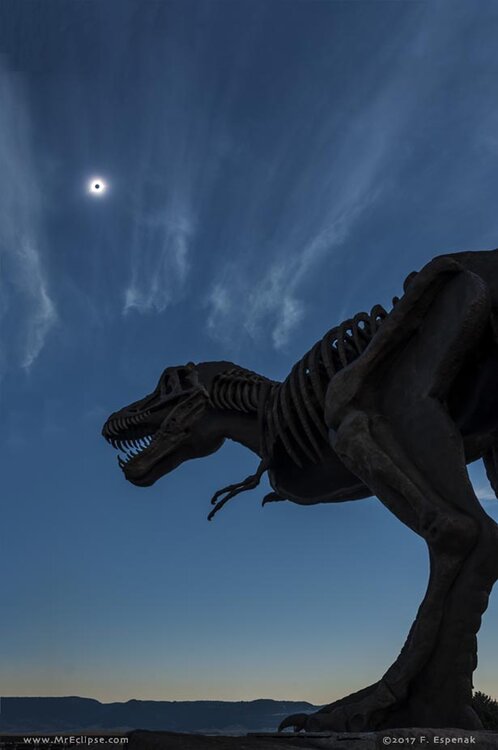
Eclipsosaurus Rex... ??? Many of the readers of this thread may remember me talking a month or so prior to the Great American Eclipse about how we have a unique perspective for eclipse-viewing here on Earth. Nowhere else in our solar system can a total solar eclipse take place like the one we viewed in August . The Moon's size and distance contribute to a wonderful coincidence for those of us who live here on Earth. The Moon is about 400 times smaller than the Sun, but it also just happens to be about 400 times closer. Hence, we get to witness total eclipses of the Sun. Sadly, as I mentioned a few months ago, this will not always be the case. The Moon is slowly inching farther and farther away from us at a rate of 1.5 inches per year due to tidal friction. 1.5 inches , you say? Nothing to worry about? Multiply 1.5 in/yr. by 600,000,000 years and you'll see the Moon will be over 14,200 miles farther away from us than it is now. That will be far enough away that the lunar disk will be too small to ever completely cover the Sun. When that time comes, at best, only annular eclipses will be seen from the surface of our pale blue dot we call Earth. Kinda sad, isn't it??? Of course, the Moon was closer to us and loomed a little larger in the sky 100 million years ago. Hence, during the age of the dinosaurs total eclipses of the Sun were more frequent. I bet the T Rex enjoyed those Sun-Moon shadow dances as much as we do!!! The picture that I offer for your enjoyment is one that was taken in front of the Tate Geological Museum at Caspar College in Wyoming. Taken on August 21 of this year(you remember that day, don't you?) , this image was snapped by an automated camera placed under the dinosaur statue to shoot his portrait as he posed with a modern-day eclipse --- the Great American Eclipse . Kinda takes you back a hundred million years or so, doesn't it? Enjoy!!!
-
Speaking of the Big Bang , Big Rocks, and .... Space Sex !!! Do you think it's ever happened? The 10,000 mile-high club? Stay tuned to this space for the ups and downs of cosmic coitus...
-
Once, right after an intimate episode, I asked my ex( a physical science teacher and astronomy enthusiast ) , "Baby, do I remind you of more of a supernova or a pulsar?" Her response.... "A white dwarf." My dream was to be with Maria Sharapova. Instead, I got Carol Burnett. Dammit.
-
Damned women... so hard to please, aren't they? My ex said I had the speed thing down pat. Who does she think she is?... Don Rickles???
-
Hey Mr. Space Weatherman, you and I are bound to be the life of parties. :lol2: Do chicks dig big space rocks???
-
I know I've referenced Sagan's "Pale Blue Dot" narrative in other threads , but not yet in the astronomy thread. I love the words. For those who are not familiar with the "Pale Blue Dot" speech, it was an excerpt from Sagan's book of the same name. Sagan's words were inspired by an image taken, at Sagan's suggestion, by Voyager 1 on February 14, 1990. As the spacecraft left our planetary neighborhood for the fringes of the solar system, engineers turned it around for one last look at its home planet. Voyager 1 was about 4 billion miles away, and approximately 32 degrees above the ecliptic plane, when it captured this portrait of our world. Caught in the center of scattered light rays (a result of taking the picture so close to the Sun), Earth appears as a tiny point of light, a crescent only 0.12 pixel in size. Look again at that dot. That's here. That's home. That's us. On it everyone you love, everyone you know, everyone you ever heard of, every human being who ever was, lived out their lives. The aggregate of our joy and suffering, thousands of confident religions, ideologies, and economic doctrines, every hunter and forager, every hero and coward, every creator and destroyer of civilization, every king and peasant, every young couple in love, every mother and father, hopeful child, inventor and explorer, every teacher of morals, every corrupt politician, every "superstar," every "supreme leader," every saint and sinner in the history of our species lived there--on a mote of dust suspended in a sunbeam. The Earth is a very small stage in a vast cosmic arena. Think of the rivers of blood spilled by all those generals and emperors so that, in glory and triumph, they could become the momentary masters of a fraction of a dot. Think of the endless cruelties visited by the inhabitants of one corner of this pixel on the scarcely distinguishable inhabitants of some other corner, how frequent their misunderstandings, how eager they are to kill one another, how fervent their hatreds. Our posturings, our imagined self-importance, the delusion that we have some privileged position in the Universe, are challenged by this point of pale light. Our planet is a lonely speck in the great enveloping cosmic dark. In our obscurity, in all this vastness, there is no hint that help will come from elsewhere to save us from ourselves. The Earth is the only world known so far to harbor life. There is nowhere else, at least in the near future, to which our species could migrate. Visit, yes. Settle, not yet. Like it or not, for the moment the Earth is where we make our stand. It has been said that astronomy is a humbling and character-building experience. There is perhaps no better demonstration of the folly of human conceits than this distant image of our tiny world. To me, it underscores our responsibility to deal more kindly with one another, and to preserve and cherish the pale blue dot, the only home we've ever known. -- Carl Sagan, Pale Blue Dot, 1994
-
Every time I ponder the Earth's future or the future of the Universe, this song comes to mind.
-
In the year 2525.... and beyond.... WAYYYY beyond! I've always been fascinated by thoughts of what our Earth, our solar system, our galaxy, and the universe as a whole will be like billions of years in the future. Let's take a little look together into the future of the solar system and the universe. 750 million years from now - The Sagittarius dwarf spheroidal galaxy makes its next pass through the Milky Way, and perhaps disintegrates. 1.1 billion years from now - The Sun becomes 10% brighter than today. Runaway greenhouse effect may evaporate the Earth's oceans. If so, the water molecules in upper atmosphere will break apart and the hydrogen will sail off into outer space. 2 billion years from now - The Andromeda Galaxy approaches our galaxy, the Milky Way. 3.5 billion years from now - The Sun becomes 40% brighter than today. Conditions on Earth resemble those on Venus today. 3.75 billion years from now - The Andromeda Galaxy nears the Milky Way 3.85 billion years from now - The Andromeda Galaxy makes its first pass by the Milky Way, leading to a burst of star formation. 3.9 billion years from now - Star formation reaches its peak as Andromeda Galaxy makes its first pass by the Milky Way. 4 billion years from now - the Andromeda Galaxy becomes tidally stretched and the Milky Way is warped after their first near-collision. 5.1 billion years from now - the cores of the Andromeda Galaxy and Milky Way will be visible as bright lobes in the sky during their second pass. There will be less star formation, because much of the interstellar gas and dust was used up by in previous burst of star formation. 5.4 billion years from now - The Sun's core runs out of hydrogen, and it enters its first red giant phase, becoming 1.6 times bigger and 2.2 times brighter than today. 6.5 billion years from now - The Sun becomes a full-fledged red giant, 170 times bigger and 2400 times brighter than today. 6.7 billion years from now - The Sun starts fusing helium and shrinks back down to 10 times bigger and 40 times brighter than today. 6.8 billion years from now - The Sun runs out of helium and, too small to start fusing carbon and oxygen, enters a second red phase. It is 180 times bigger and 3000 times brighter than today. 6.9 billion years from now - The Sun begins to pulsate every 100,000 years, ejecting more and more mass in each pulse, and finally throwing off all but the hot inner core, becoming a white dwarf. 7 billion years from now - the cores of the Andromeda Galaxy and Milky Way merge to form a large elliptical galaxy ("Milkomeda"). The aging population of stars is no longer concentrated along a plane, but instead spread out in an ellipsoid. Star formation diminishes. 10^13 years from now - The smallest and longest-lived stars capable of supporting fusion today, red dwarf stars with a mass about 0.08 times that of the Sun, run out of hydrogen. 10^14 years from now - All normal star formation processes cease. The universe settles down with a population of stars consisting of about 55% white dwarfs, 45% brown dwarfs and a small number of neutron stars and black holes. Star formation continues at a very slow rate due to collisions between brown and/or white dwarfs. 10^17 years from now - All currently existing white dwarf stars cool to black dwarfs with a temperature of at most 5 Kelvin. 10^19 years from now - All galaxies "boil off", gradually losing their dead stars to intergalactic space. 3 × 10^22 years from now - All binary brown stars spiral in and collide due to gravitational radiation. 10^23 years from now (That's 100 sextillion, btw)- All galactic clusters boil off. Temperature: 10^ -13 Kelvin. From then on: the Universe expands exponentially and cools down to a temperature of 10^ -30 Kelvin. All black holes eventually evaporate, and all other forms of matter eventually disperse into individual elementary particles. So, as you can see, what began some 13.8 billion years ago as one great big explosion, will become just a cold, dark nothingness a hundred sextillion years or more from now... Of course, the ultimate fate of the universe is determined by its density. The preponderance of evidence to date, based on measurements of the rate of expansion and the mass density, favors a universe that will continue to expand indefinitely, resulting in the "big freeze" scenario I outlined above.
-
You better believe they are ever bit the championship contender. Anyone that ever counts out Mayfield does so at their own peril!!! I expect them to be right there at the end.
-
How old is the universe? When talking in terms of physical cosmology, the age of the universe refers to the amount of time that has has elapsed since the Big Bang. The current, best measurements put the age of the universe at 13.799 +or- 0.021 billion years. The uncertainty has been narrowed to just 21 million years recently using a number of different parameters that all give very nearly the same age for our universe. Btw, back in 2012 , NASA's WMAP estimated the age at 13.772 + or - 0.059 billion years and in 2015 Planck estimated the age at 13.813 + or- 0.038 billion yrs. Using analyses of microwave background radiation, along with the measurements by Planck and WMAP, as well as other several other parameters, we get the relatively narrow interval above of (13.778 , 13.820) billion years. By measuring the background radiation, we can determine the cooling time of the universe since the Big Bang. Also, measurements of the rate at which the universe is expanding can be used to approximate its age by extrapolating backwards. I got to thinking the other night about how long humans have been on Earth. Considering the age of the universe, humans have been here for a very, very short period of that time. Let's think in terms of say, a cosmic calendar, of sorts. If the universe was born(Big Bang Boom!!!) on midnight January 1 and the present time represents the end of the day on Dec. 31, when did humans first appear ??? Any idea? Let's do a simple arithmetic calculation. Modern day humans(homo sapiens) first appeared about 200,000 years. The universe is 13.8 billion years old. 200,000 / (13.8X 10^9) = 0.00001449275 yrs. = approximately 7 min. , 37 seconds. That's right--- we humans have been on board this pale blue dot flying through space for just a little over 7 and one half minutes of the one "cosmic calendar year" since the Big Bang got it all started. That means, according to our cosmic calendar, humans came on the scene on Dec. 31 at 11:52: 23--- just 7 min. , 37 seconds ago!!! Took a lot of time for the universe to finally give birth us crazy people here. Wonder how long will it take us to destroy ourselves ???
-
I'm ready for this rock. Bring it on!!!!
-
Plus, they cheat, right? You are precious.
-
I predict no running clock!!!
-
delete
-
Until it's proven different on the gridiron I'm still going with 1. Belfry 2. Boyle 3. Corbin. I think any of these three could win a state title if the breaks go their way. I feel like Boyle and Corbin are very close and Belfry a score or so better. But what do I know? I think it very probable that Cabell would lose to all three of the top 3A KY teams.
-
For what it's worth... calpreps says ... Corbin 35.3 Belfry 33.2 Cabell 26.7
-
Passenger plane approaching Heathrow Airport in the light of the big luminous Harvest Moon.

-
Did anyone see the Harvest Moon Thursday night? What a sight!!! I was out running and it almost took my breath away(well, maybe it was the running). The Harvest Moon refers to the first full moon after the autumnal equinox, which took place on Sept. 22. The name of the moon, however, may vary, depending on which culture's literature you consult. Harvest moons are rare in October, and they are set to occur only 18 times between 1970 and 2050; usually the full moon occurs much closer to the autumnal equinox, which would make the Harvest Moon fall in late September. I think 2009 was the last time since we had a Harvest Moon in my birth month of October.