Science Friction
Suspended
-
Joined
-
Last visited
Everything posted by Science Friction
-
I honestly would have rather be kicked in the walnuts really hard than to lose my hair on the court. Seriously... kick me!!!
-
In with a Bang, out with a ... About 13.8 billion years ago, our entire visible universe was contained in an unimaginably hot, dense point about a billionth the size of a nuclear particle. Since then, it has expanded... A LOT !!! In this post, I want to talk just briefly about different periods in the life of the universe, but mostly I want to speculate , not so much about what happened at the beginning, but how it's all gonna end. First, let me take you back(WAYYY back) to the infant universe. Inflation: In FAR less than a nanosecond(a billionth of a sec.), a repulsive energy field inflated space to a visible size and filled it with a soup of subatomic particles called quarks. A quark is a type of elementary particle and a fundamental constituent of matter. Quarks combine to form composite particles called hadrons, the most stable of which are protons and neutrons, the components of atomic nuclei. Age of Universe at this time: 10^ -32 milliseconds Size of the universe: Infinitesimal to about the size of a golf ball Those Quarky Quarks: The baby universe expanded, cooled. Quarks clumped into protons and neutrons, the building blocks of atomic nuclei. Age of universe at this time= 1/100 of a millisecond( or 1/100,000 of a second) Size = About a trillionth its present size H and He Come on the Scene: As the universe continued to cool, the lightest nuclei, that of hydrogen and helium, are born. A thick fog of particles blocked out all light. Age of the universe = 1/100 of a second to 3+ minutes Size = About 1-billionth its present size "Let there be light": Electrons began orbiting nuclei, thus creating atoms. The glow from our infant universe was unveiled. We had light!!! This early light is as far back as our modern instrumentation can see. Age of the universe = about 380,000 yrs. Size = 9/10,000 of its present size "The Dark Ages" : For some 300 million yrs the cosmic background radiation was the only light. Clumps of matter that would eventually become galaxies glowed brightest. Age of universe= 300 million yrs. Size = About 1/10 its present size Gravity wins and the stars turn on : Dense clouds of dust and gas collapsed under their own gravity, as well as that of dark matter , and eventually formed the stars and galaxies. Nuclear fusion lit the stars!!! Age of universe: 300 million yrs. Size: About 1/10 its present size. Anti-Gravity Finally Wins the Tug-of-War: After being slowed for billions of years by gravity, the expansion of the universe once again accelerated. The big, powerful culprit--- Dark Energy!!! To this day, we still are not clear as to its nature, but we know that dark energy , along with dark matter make up more than 95% of the universe. That's right, the vast majority of the universe cannot even been seen!!! Age of the universe at this time= 10 billion yrs. Size= About 77/100 its present size. Fast Forward to... the Present !: Today, the universe continues to expand, becoming less and less dense. As a result, fewer new stars and galaxies are forming. Age of universe= 13.8 billion yrs. Size= Present While we have learned much in recent decades about the early universe, still many questions remain. As you can see, the lifetime of the universe has featured a no holds barred battle royal between gravity and anti-gravity. Which force will win out in the end? There are three possible scenarios for what is likely the eventual fate of the universe. The theory you subscribe to probably depends upon which you think is the stronger force- gravity or anti-gravity. 1) Is the density of matter enough for gravity to halt or even reverse the present cosmic expansion, leading to a "Big Crunch." In other words, will gravity eventually cause the universe to collapse back onto itself? That will be one heck of a crunch! I wouldn't want to be around for that. I personally don't think this scenario is likely, given the immense power of dark energy, a kind of anti-gravity, that makes up almost 70% of the universe(dark matter makes up most of the remainder). 2) If you are in the dark energy/anti-gravity camp, you likely think that the acceleration in the universe's expansion caused by dark energy will trigger a "Big Rip" that will shred everything from galaxies to atoms. In this scenario, the expansion will accelerate to the point that everything in the universe will be ripped to shreds. 3) Those like myself who don't believe we will be crunched or ripped believe that the universe is likely to continue to expand for hundreds of billions of years, long after ALL the stars have shut down and gone "night night." Yes, I think the universe is likely to outlive even the last flicker of starlight. The universe, in my opinion is destined to work a perpetual and infinite graveyard shift among a cold, dark, void of nothingness. I say, in with a bang.... out with a whimper !!! I would be interested to hear what you think. Do you think the end is most likely gonna be a Big Crunch , a Big Rip, or Infinite expansion? I actually sit and ponder things like this a lot. The end of times is somehow even more fascinating to me, at times, than the beginning. I wish I knew our ultimate fate... or do I???
-
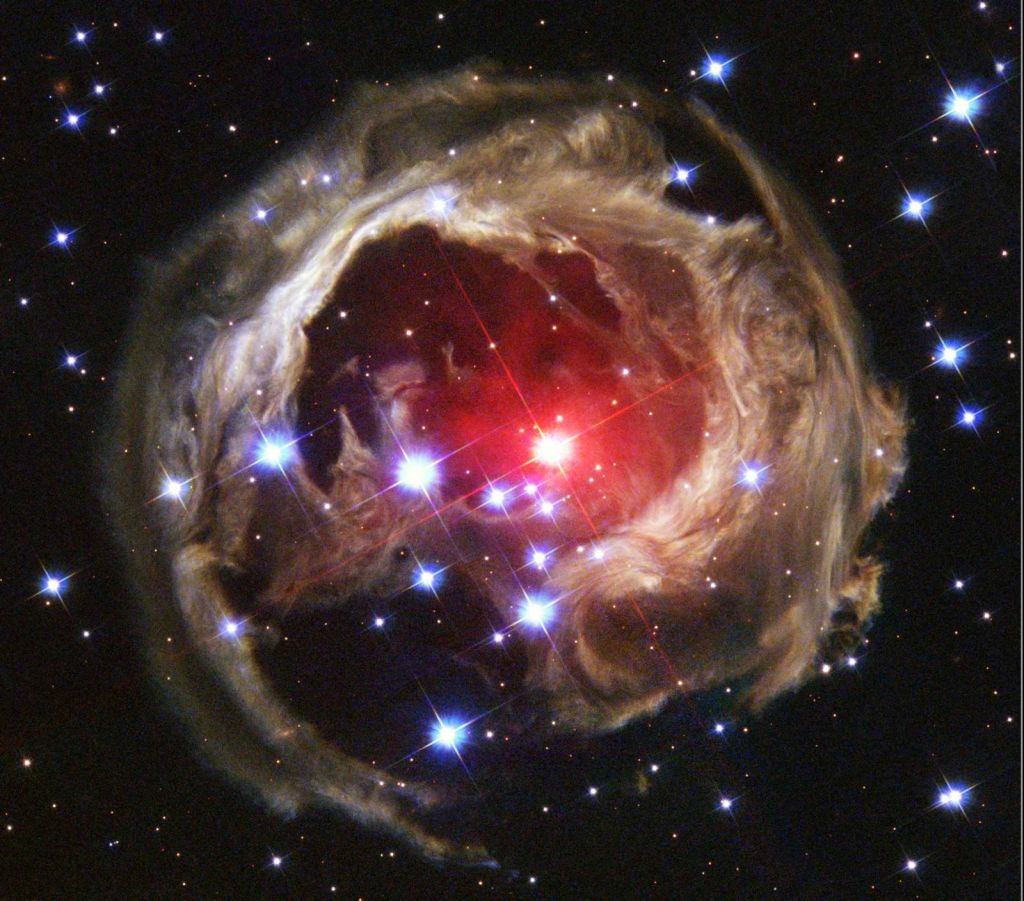
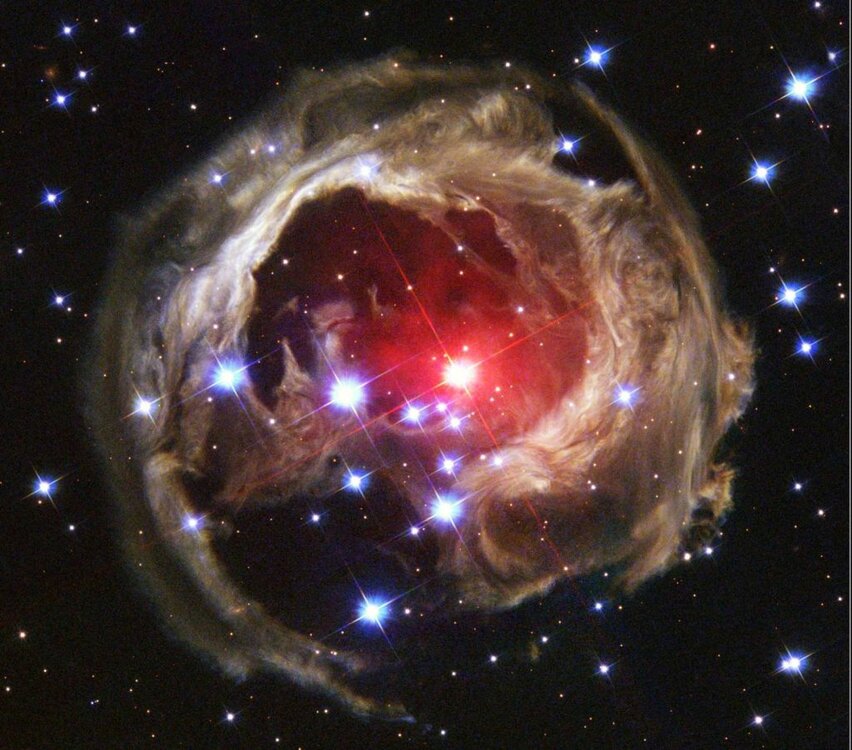
Found in the Constellation Monoceros, this is the star, V838Mon, along with the dust and gas that surrounds it. It's about 20,000LY from us and about 13.7LY across. Up until early on in this century, it seemed like just another ordinary star. But 15 years ago this month, the star flashed and became 4,000 times brighter. In fact, it was the brightest star in our Milky Way galaxy for several weeks after the flash. Then just as suddenly, it faded. A stellar flash like this had never been seen before. While the V838Mon flash appears to expel material into space, what appears here is an outwardly moving light echo of bright flash. The star continues to be the subject of intensive study.
-
I saw both of these teams play recently. Scott v. South Laurel and Pendleton v. Corbin. I really enjoyed watching both of them. Two quality teams with some really nice athletes.
-
Ouch!!! 10-30... is that correct? That's brutal. I carry around calculus books for a living and I could hit a better percentage than that.
-
You're right, if he turns out to be that big presence we need, the Hounds will be a tough out for anyone.
-
BR suited up for the first time but didn't play.
-
I love the Horsehead as well. Just breathtaking! I also love those Pillars of Life.
-
I would agree with that. I know one thing that few would argue; these two young men are fun to watch.
-
I'm gonna go watch him again tonight and then I'll get back with you. In your opinion, why is Faulkner better? I may be letting my bias guide me.
-
Excellent assessment. I love watching two superb talents like Taylor and Faulker go at it. You could tell that each young man was having a ball putting on a show for the fans. Faulkner obviously has never met a shot he didn't like. He has Steph Curry range. Taylor is the better player but Faulkner is fun to watch as well.
-
Some space missions that you may be reading about in 2018: BepiColombo The European Space Agency, working with the Japan Aerospace Exploration Agency, is looking forward to starting their first-ever trip to Mercury next year. This is one of the least explored planets in the solar system, and the environment there is intense, to put it mildly. The spacecraft will endure massive temperature variations, with highs of 800 degrees Fahrenheit (427 degrees Celsius) and lows around -280 degrees Fahrenheit (-173 degrees Celsius). The craft’s mission, when it reaches Mercury in 2025, will last about a year, and if they get lucky, maybe two. Chang’e 4 As China’s second lander mission to the Moon, Chang’e 4 is a followup to previous versions, namely Chang’es 1,2, and 3. In the time since those missions’ development, the China National Space Administration has dramatically improved its technology and predictions. They intend to explore parts of the Moon starting with a relay orbiter and are following it up with a lander and a rover. Mission scientists are currently looking at landing on the far side of the Moon, the side we never get to see. However, those plans may be disrupted if they discover another area that looks more promising. Starliner: Boeing’s Manned Launch Boeing has been hired by NASA as part of its ongoing program to find a better way to get people into space. They, along with other companies like SpaceX, have been working toward a manned launch and in 2018, Boeing is expected to try it. The Starliner is a whole new design: a weldless structure that can transport up to seven crewmembers or a mix of crew and materials. For its first manned flight, Boeing will be doing the mixed bag. They’ll be sending four NASA astronauts in addition to materials and data to the International Space Station. If all goes well, they will be the front-runners for NASA’s Commercial Crew Program. Solar Orbiter Another brainchild the ESA, the Solar Orbiter (SolO) is set to launch and start studying the Sun, which you might’ve been able to guess from its name. It will investigate heliocentric and solar physics. As a part of the larger Cosmic Vision Program, the SolO is only a small component of a much larger, ten-year program. The SolO was initially set to launch in 2017, but was delayed to ensure that the program could complete all of its goals with minimal issues. As the first medium program of Cosmic Vision, the pressure is as high as the goal. Insight Insight, which stands for Interior Exploration using Seismic Investigations, Geodesy and Heat Transport, is a NASA probe that will launch next year and head for Mars. Its goal is different than the previous rovers that have covered Mars’ surface — it will instead seek to find out about how the planet was formed. The lander, which is planned to launch in May of next year, will examine the deepest layers of the planet, tracking its temperature differences and tectonic plate movements, among others. Scientists hope that the information we get will help us to learn how other planets are formed, both within our solar system and without. Chandrayaan-2 The Indian Space Research Organization (ISRO) is also planning a launch for 2018. They will be sending Chandrayaan-2, a followup to Chandrayaan-1, to the Moon. Similar to Chang’e 4, but with an original plan, their mission is to use an orbiter, lander, and rover to explore more of the Moon’s surface. Unlike other countries' missions to the Moon, the orbiter will create a 3-D map of the Moon’s surface. While we do have other maps of the Moon, this is the first time India has crafted their own using an original plan without foreign aid. The lander will take a look at the Moon’s crust and mantle. Some of the mission’s technology is from Roscosmos, the Russian space agency. James Webb Space Telescope(new launch date- 2019) The Hubble gave us incredible images of deep space that significantly expanded our understanding of the universe. Its successor is the James Webb Space Telescope, which was originally set to launch in October 2018 and will now launch between March and June 2019. This telescope will be even bigger than the Hubble, and therefore able to capture images of deeper space than Hubble could. It will also be able to provide more detail than its predecessor, but because it needs to use rocket fuel constantly, is unlikely to last as long. I'll keep you updated ...
-
The Redhounds face a very talented Mercer County team that just beat 8th- ranked Pulaski Co. by ten points in the KOB. This could be a trap game of sorts for the Redhounds with a potential matchup against Knox Central looming Saturday night. It will take a focused effort tonight to gain the victory, in my opinion.
-
If Andrew averages around 26 pts. per game the remainder of the season(he averaged 29 last year), he will finish his career as the second most prolific scorer in Kentucky High School basketball history behind only King Kelly Coleman !!!
-
I want to thank all of my BGP astronomy enthusiasts for all of your insights that you have posted in this thread since the past summer. It's been a lot of fun talking about our universe and reading your thoughts as well. A special thank you goes out to all of the frequent posters in the thread, including The Professor, Renuncible Owl, B-Ball-fan, TB&G , and my trusty space weather guy, Bluegrasscard. I appreciate all of you , as well as those who just stop in to read. Please continue to drop in from time to time and let me hear your thoughts. I wish I had more time to talk about astronomy because it really is my passion, and has been since I was six years old. I hope you will join me in some interesting discussions in 2018. As I've said before, I never grow tired of learning about our universe. I'll leave you with one of the most identifiable nebulae in the sky, and one I've shared with you before. The Horsehead Nebula in Orion, is part of a large, dark, molecular cloud. Also known as Barnard 33, the unusual shape was first discovered on a photographic plate in the late 1800s. The red glow originates from hydrogen gas predominantly behind the nebula, ionized by the nearby bright star Sigma Orionis. The darkness of the Horsehead is caused mostly by thick dust, although the lower part of the Horsehead's neck casts a shadow to the left. Streams of gas leaving the nebula are funneled by a strong magnetic field. Bright spots in the Horsehead Nebula's base are young stars just in the process of forming. Light takes about 1,500 years to reach us from the Horsehead Nebula. The image below was taken with a large 3.6 m telescope in Hawaii.

-
Here are some astronomical events in 2018 that I will be watching for. Will you join me in turning your eyes(and binoculars) to the sky and enjoying the wonders of the universe in 2018? 1. Super Blue Moon Eclipse — Jan. 31 For the first time in over 35 years, a total lunar eclipse will fall on the same night as a Blue Moon. January will feature two full moons, the second of which earning the name of a Blue Moon. Both full moons will also be considered super moons, appearing bigger and brighter than normal. Although the full moon on Jan. 31 is called a Blue Moon, it will not appear blue. In some parts of the world, the moon will turn a rusty orange color due to the effects of a total lunar eclipse. During a total lunar eclipse, the moon passes through Earth’s shadow and turns a red or orange color during the height of the eclipse. Sometimes, this is referred to as a Blood Moon. This will be the first time that a total lunar eclipse has occurred during a blue moon since Dec. 30, 1982. Only a partial lunar eclipse will be visible for the contiguous United States as the moon begins to set before dawn on Jan. 31. Alaska and Hawaii will be the only states in the United States that will be able to view a total lunar eclipse. Eastern Asia and Australia will also be able to view the total eclipse with the rest of Asia seeing a partial eclipse as the moon begins to rise. 2. Mars reaches opposition, comes closest to Earth since 2003 — July 27 Mars will appear big and bright in night sky this year, reaching its peak brightness at the end of July. About once every two years Mars reaches opposition. This phenomenon occurs when Mars appears opposite of the sun and when it is closest to the Earth. This year will be a particularly good year for viewing Mars as it will be the closest it has been to the Earth since 2003. Mars will be easy to find when it reaches opposition on July 27 since it will appear just below the full moon. It will also appear red in color, setting itself apart from the other planets and the countless stars in the night sky. Evening stargazers will also be able to see Saturn and Jupiter when Mars is at opposition. 3. Perseid meteor shower — Aug. 12-13 The best meteor shower of the summer will reach its peak during the second weekend of August, boasting up to 60 meteors per hour. This shower is routinely one of the best and most popular meteor showers of the year and is well known for very bright and long-lasting meteors. This year will be a good year for the Perseids as the peak of the shower falls just after a new moon. The lack of moonlight will make it easier to see many of the dimmer meteors. 4. Two comets to glide past Earth — December Two comets will be making close approaches to Earth at the end of the year, giving stargazers new objects to look for with their telescopes. Comet 46P/Wirtanen will be the brighter of the two comets and could become bright enough to spot with the unaided eye around mid-December. However, it will be best seen through the lens of a telescope or pair of binoculars. Comet 46P/Wirtanen will be making its closes approach to Earth around Dec. 17 and will appear to the left of the the Pleiades star cluster. Comet 38P/Stephan-Oterma will be another comet to look for in the December sky as it flies through the inner solar system for the first time in 38 years. This comet will require a telescope to see as it will not be as bright as Comet 46P/Wirtanen. Stargazers should point their telescopes between the Gemini and Ursa Major constellations to look for the comet when it reaches peak brightness during the first few days of December. The next time that Comet 38P/Stephan-Oterma will appear this bright won't be until the fall of 2056. 5. Geminid meteor shower — Dec. 13-14 One of the last astronomy events of the year will also be one of the best as the Geminid meteor shower reaches its peak the week before the start of winter. Onlookers may see up to 120 meteors an hour on the night of Dec. 13 into the morning of Dec. 14 with some meteors glowing in different colors as they burn up in Earth’s atmosphere. The Geminid meteors comprise one of the few showers active during the evening, but in 2018, the best viewing conditions will be after midnight once the crescent moon sets. During a meteor shower, the shooting stars originate from a point in the sky, known as the radiant point. However, meteors will be visible in all areas of the sky. I usually find me a nice, dark pace , lay down a blanket and just look up at all areas of the night sky for a couple of hours. Happy star-gazing everyone !!!
-
B-ball-fan, thanks for watching the video. You are right, btw. Even a billion years from now, if our species is still around(doubtful), it will in no way resemble what we know today. My guess is that we will have long disappeared from this planet by then and possibly taken up residence somewhere else in the universe. Still, it is kinda interesting to speculate on what it would be like if we were still around when the sun went all "red giant" on our butts. I think we can all agree it wouldn't be pretty.
-
As 2017 draws to a close, I'm reflecting on the year in astronomy. Of course, the GAE dominates my consciousness. The eclipse event was really something special. Being able to experience totality was a soul revival, a hyper-sensitive awareness of our close connection to the Universe. I can't wait until the 2024 total eclipse, which will have nearly twice the duration of totality as the GAE of 2017. I love this image of an owl at a bird sanctuary in Missouri observing the sun being eclipsed on Aug. 21 . You can see the reflection of the eclipse in the little bird's eye. [ATTACH]63471[/ATTACH]
-
Another favorite of mine is also a NatGeo presentation from the Naked Science series entitle "Swallowed by the Sun." The show is only about 45 min. in duration. It shows what will happen to the Earth when the sun enters its dying phase a few billion years from now. Long before the sun has used up its supply of hydrogen, life for us will be impossible. This show is for those curious about our planet's future as our sun begins to die. Please be aware, this is a chilling and foreboding tale about what will happen when the star that gave us life grows bigger and hotter and eventually consumes us. I think you will find this both fascinating and haunting. Enjoy. I welcome your comments.
-
HIGHLIGHTS + REACTION: Corbin's Andrew Taylor breaks 3,
-
You won't find a better young man than Corbin's Andrew Taylor. Unselfish, humility, & spiritual are all words that come to mind. However, don't let his quiet demeanor and genuine humility fool you... his gentle countenance belies a burning desire to break your team's will. "Silent Death" :

-
3,000 pts. 1,000 reb. 1 Big Ticker ! Congrats A.T. !!!

-
Watching "Journey to the Edge of the Universe" for probably the 80th time. I'm sure many of you have seen the Nat Geo production. If not, it is well worth the hour and a half. Baldwin is great as narrator, great script and computer-generated imagery.. I just wish it had been three or four hours in length, with even more detail about some of the deep space objects.
-
Johnny Carson as Carl Sagan . Hilarious! Professor, you will love this. You may remember the skit.
-
Johnny was an astronomy enthusiast. He even did skits with himself playing Sagan. Here's Johnny doing a promo on California's Educational Television channel for an upcoming episode of Sagan's terrific series "Cosmos."