
Science Friction
Suspended
-
Joined
-
Last visited
Everything posted by Science Friction
-
Jags are in a funk. Loss to rabbits and now bears.
-
Yes, thank you. Earthshine is occurring because sunlight is reflecting off the Earth's surface and illuminating the unlit portion of the waxing crescent moon. This is a dull, or pale, glow of light compared to the lit portion of the moon since it is twice-reflected light, first off the Earth's surface, then off the moon's surface. Does anyone know who was the first person to explain this Earthshine phenomenon? (It wasn't me or TB&G) Hint: He was pretty good at using light and color to his advantage.
-
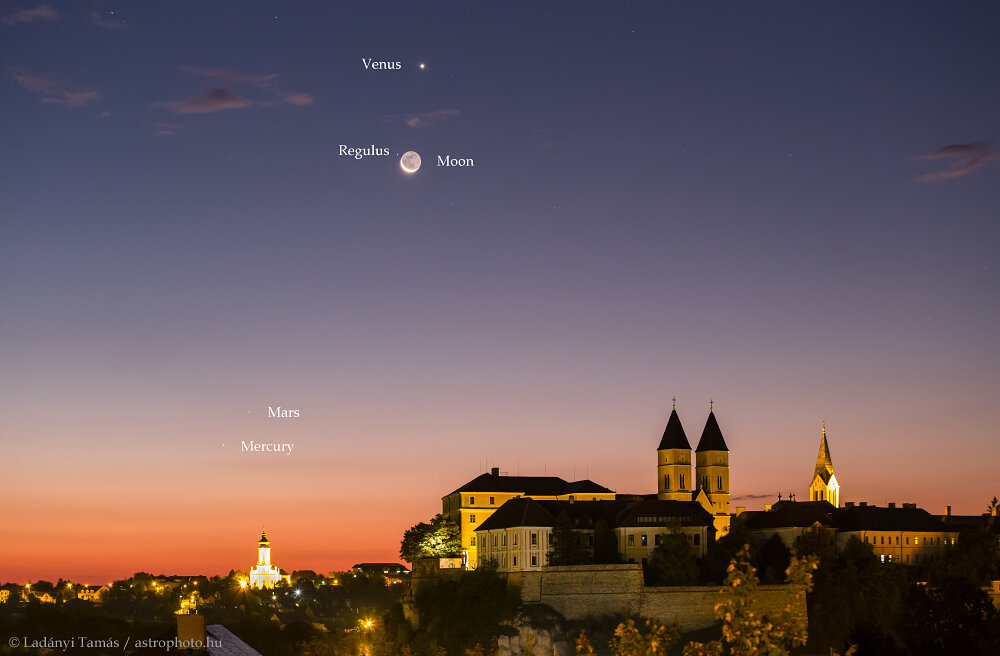
Dawn Breaking over Hungary... I mentioned the other day about the morning alignment of the Moon, three planets, and Regulus in the pre-dawn sky. Bluegrasscard posted some pics of what he observed that morning. Here is a lovely picture of the morning sky over Hungary on the 18th. In this twilight skyscape, Mercury and Mars still shine close to the eastern horizon, soon to disappear in the glare of the Sun. Regulus, alpha star of the constellation Leo, is the bright point next to a waning crescent Moon, with brilliant Venus near the top of the frame. The beautiful morning conjunction of Moon, planets, and bright star could generally be followed by early morning risers all around planet Earth. But remarkably, the Moon also occulted, or passed directly in front of, Regulus and each of the three planets within 24 hours, all on September 18 . It won't be until 2036 when the Moon will again occult three planets in less than one day.
-
Interesting post. Glad to have you on board. Hope to hear more of your thoughts.
-
Okay, okay --- I'm still not over the eclipse. There is nothing quite like seeing the sun's magnificent corona during a total eclipse. I know that August 21 is a day that I will never forget. It is hard to adequately describe seeing that majestic crown of hot gases first hand. No photograph can do it justice. But this one is pretty nice. The human eye can adapt to see coronal features and extent that average cameras usually cannot. Welcome, however, to the digital age. The picture below is a combination of forty exposures from one thousandth of a second to two seconds that, together, were digitally combined and processed to highlight faint features of the total solar eclipse that occurred on August 21. Clearly visible are intricate layers and glowing caustics of an ever changing mixture of hot gas and magnetic fields in the Sun's corona. Looping prominences appear bright pink just past the Sun's limb. Faint details on the night side of the New Moon can even be made out, illuminated by sunlight reflected from the dayside of the Full Earth.

-
Tuesday, September 19 Uranus reaches opposition one month from today, but it already has become a tempting evening target. The ice giant world rises before 9 p.m. local daylight time and climbs some 30° above the eastern horizon by 11 p.m. The magnitude 5.7 planet lies in Pisces, 1.1° northwest of magnitude 4.3 Omicron (o) Piscium. Although Uranus glows brightly enough to see with the naked eye under a dark sky, binoculars make the task much easier. A telescope reveals the planet’s blue-green disk, which spans 3.7". Wednesday, September 20 New Moon occurs at 1:30 a.m. EDT. At its new phase, the Moon crosses the sky with the Sun and so remains hidden in our star’s glare. Thursday, September 21 Although you can’t see the Moon around its New phase, its absence from the morning sky these next two weeks provides observers with an excellent opportunity to view the zodiacal light. From the Northern Hemisphere, early autumn is the best time for viewing this elusive glow before sunrise. It appears slightly fainter than the Milky Way, so you’ll need a clear moonless sky and an observing site located far from the city. Look for a cone-shaped glow that points nearly straight up from the eastern horizon shortly before morning twilight begins (around 5 a.m. local daylight time at mid-northern latitudes). The Moon remains out of the morning sky until October 4, when the waxing gibbous world returns and overwhelms the much fainter zodiacal light. Friday, September 22 With the days growing shorter and kids back in school, it shouldn’t be surprising that summer’s reign is just about over. The warmest season comes to an official close at 4:02 p.m. EDT, when Earth reaches the autumnal equinox. This marks the moment when the Sun crosses the celestial equator traveling south. Our star rises due east and sets due west today. If the Sun were a point of light and Earth had no atmosphere, everyone would get 12 hours of sunlight and 12 hours of darkness. But the air and finite size of our star make today a few minutes longer than 12 hours. The Moon appears as a waxing crescent low in the west-southwest during evening twilight. Tonight, you can use it as a guide for finding Jupiter. Although the gas giant planet has been a conspicuous evening object for the past several months, it’s now nearing the end of its reign. The giant planet lies 8° to the lower right of the Moon but just 6° above the horizon a half-hour after sundown. Still, at magnitude –1.7, Jupiter shines brightly enough to appear prominent against the twilight glow. Saturday, September 23 The variable star Algol in Perseus reaches minimum brightness at 2:56 a.m. EDT. Observers on the East Coast who start watching around midevening on the 22nd can see the star’s brightness diminish by 70 percent over the course of about five hours. Those in western North America will see Algol brighten noticeably from late evening until dawn starts to paint the sky, when the star passes nearly overhead. This eclipsing binary system runs through a cycle from minimum (magnitude 3.4) to maximum (magnitude 2.1) and back every 2.87 days. Sunday, September 24 Although autumn arrived with the equinox two days ago, the Summer Triangle remains prominent in the evening sky. Look high in the west after darkness falls and your eyes will fall on the brilliant star Vega in the constellation Lyra the Harp. At magnitude 0.0, Vega is the brightest member of the Triangle. The second-brightest star, magnitude 0.8 Altair in Aquila the Eagle, lies some 35° southeast of Vega. The asterism’s dimmest member, magnitude 1.3 Deneb in Cygnus the Swan, stands about 25° east-northeast of Vega. For observers at mid-northern latitudes, Deneb passes through the zenith around 9:30 p.m. local daylight time, more than an hour after the last vestiges of twilight disappear.
-
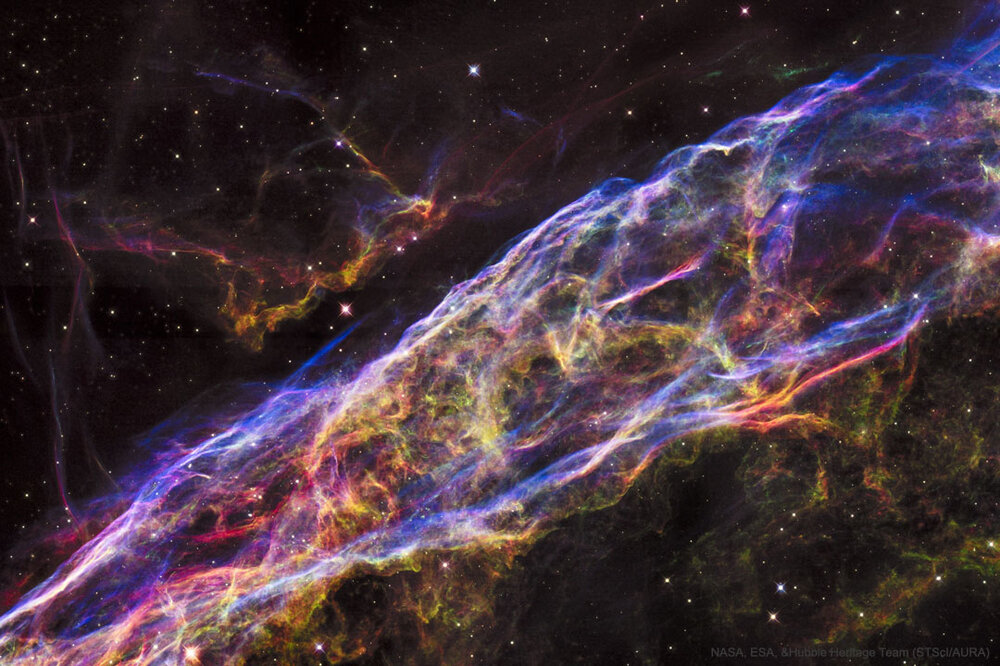
The image below looks almost like some kinda strange creature that Jacques Cousteau might have encountered in the deep ocean. In fact, these wispy filaments are all that remains of a Milky Way star that exploded in a supernova about 7,000 years ago, leaving behind what we know today as the Veil Nebula. At the time of the explosion, the expanding cloud was likely as bright as a crescent Moon, remaining visible for weeks to people living at the dawn of recorded history. Today, the resulting supernova remnant, also known as the Cygnus Loop, has faded and is now visible only through a small telescope directed toward the constellation of the Swan (Cygnus). The remaining Veil Nebula is physically huge, however, and even though it lies about 1,400 light-years distant, it covers over five times the size of the full Moon. The image below is a Hubble Space Telescope mosaic of six images together covering a span of only about two light years, a small part of the expansive supernova remnant.
-
If life exists anywhere within our solar system(outside of our own pale blue dot, of course), where would you think the most likely site would be? This is the topic that I am gonna take up very soon. Before I do so, I think I will talk first about a planetary system OUTSIDE of our solar system which may harbor life. Stay tuned to this space for some information about this planetary system, which features seven temperate terrestrial planets orbiting an ultra cool dwarf star. Three of the planets lie within the habitable zone. Interesting, huh?
-
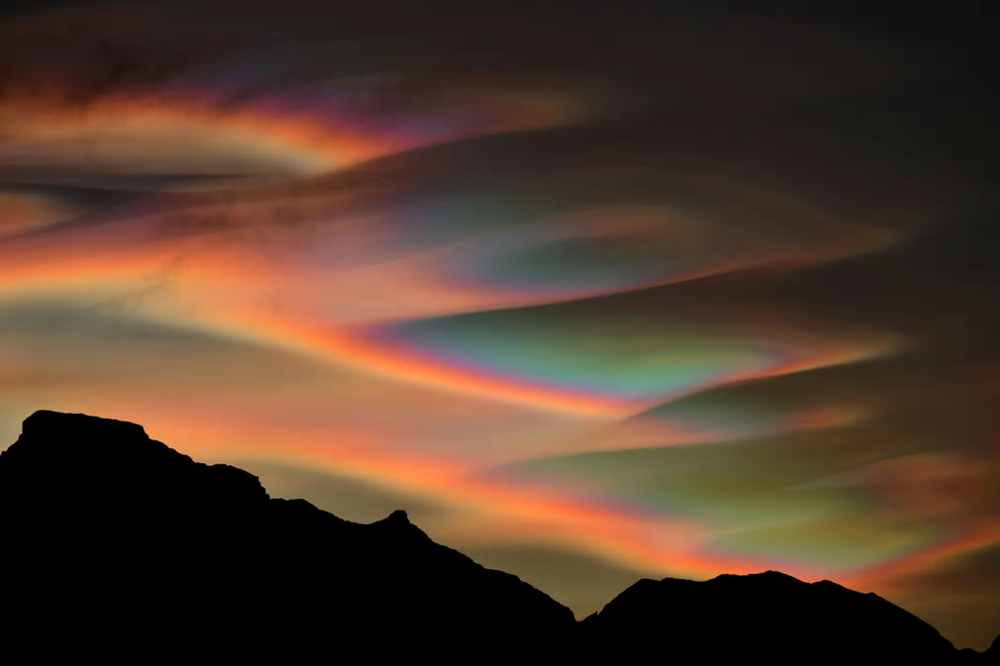
Nacreous Splendor... This amazing image was captured last New Year's Eve . A spectrum of color rolls across the sky over Norway in the form of nacreous clouds, also known as mother-of-pearl clouds due to their almost shimmering appearance. Formed over the Polar Regions in the stratosphere, when the Sun is just below the horizon at sunset it will illuminate the clouds from below.
-
I don't think anyone could look at those last couple of images( the nebula and the Northern Lights) and say that our universe isn't stunningly beautiful.
-
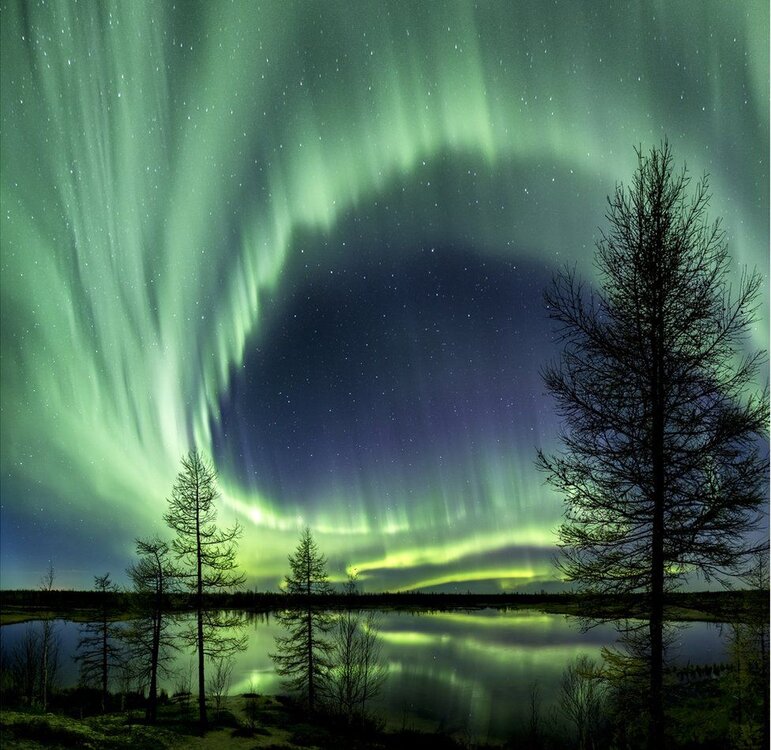
Green Northern Lights over the Siberian forest tundra:
-
A dark nebula of gas and dust in the constellation Ophiuchus , the Rho Orphiuchi Cloud Complex is one of the closest star-forming regions to our solar system. It is located a distance of about 460 LY from us. The image below was taken from a farm in Namibia(south Atlantic coast of Africa) over a course of three nights.

-
1. You may be on to something. 2. You may be doing your best Lou Holtz. 3. you may be both 1 and 2.
-
Right now: 1. Belfry 2. Boyle 3. Corbin I'm liking Boyle more and more.
-
Nice!!!!! Thank you for posting. It was a nice morning for viewing. Mars was especially tricky. Needed my high-powered binocs.
-
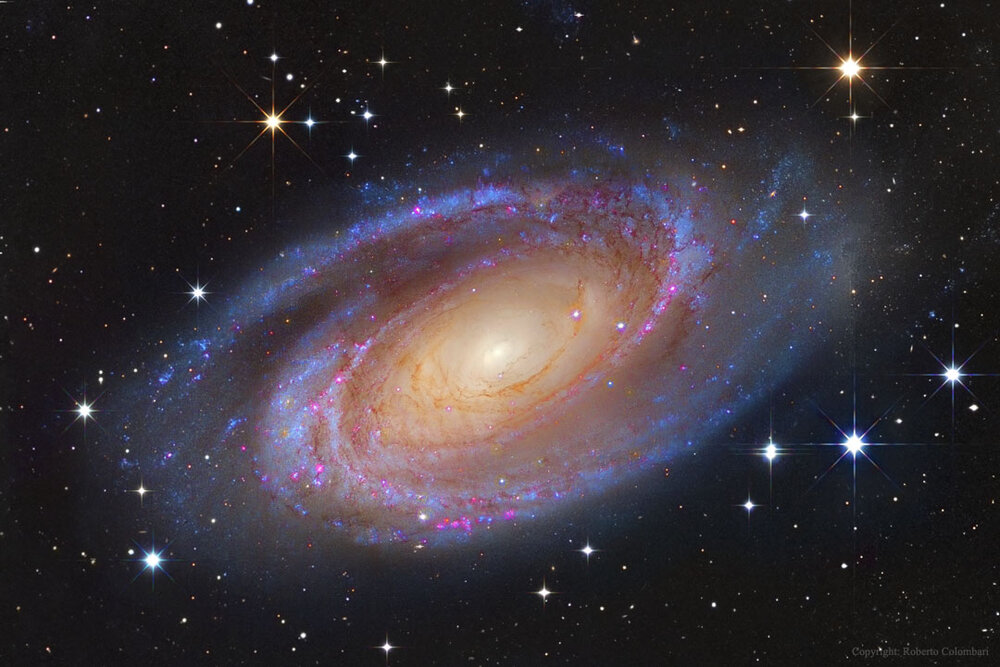
Here's the grand spiral galaxy , M81(also called Bode's galaxy after its discoverer,Johann Elert Bode) Because of its large size, its proximity to Earth, and its active galactic nucleus(there's a supermassive black hole at its center), M81 has been a source of extensive study by professional astronomers and a favored target of amateur star sleuths as well. One of the brightest galaxies in our sky, M81 is similar in size to our Milky Way. Notice M81's bright yellow nucleus, blue spiral arms, and sweeping cosmic dust lanes. Hinting at a disorderly past, a remarkable dust lane actually runs straight through the disk, to the left of the galactic center, contrary to M81's other prominent spiral features. This dust lane may be the result of a collision between M81 and its smaller companion galaxy, M82. By studying variable stars in M81 , astronomers have determined the galaxy to be about 11.74 million light years from Earth. Enjoy!!!
-
Mamaw, I miss hearing from you as well. You still reading ?
-
Occultations Galore ... Count them --- All Four!!! September 18,2017 will mark the first time since March of 2008 that three planets have been occulted by the Moon in a span of less than 24 hours. Mercury, Venus, and Mars will all be hidden by the Moon tomorrow, as will the bright star, Regulus. That's four occultations in one day!!! While that's a pretty cool happening for space nerds like me(it won't happen again until 2034), don't get too excited. You will not likely see any of the occultations. You will likely have to settle for trying to spot the Moon , Venus, Regulus, Mercury, and Mars in the pre-dawn sky. Spotting the latter two planets will take a deliberate effort(and binoculars) because of their proximity in the sky to the increasing morning light. Back to the occultations... The moon will occult Venus first (1 UTC), the star Regulus next (5 UTC), then Mars (20 UTC) and finally Mercury (23 UTC). To see any one of these occultations, however, you have to be at just the right spot on Earth. Even at that, the occultations of Regulus, Mars and Mercury will be extremely hard to observe because they occur in a daytime sky. The occultation of Venus, will also occur during the day but will be observed only by sharped-eyed observers in the Southern Hemisphere. So... cool phenomenon but not very practical viewing.
-
If you are up before dawn Monday morning, look for three planets as well as Regulus. You will likely need binoculars to spot Mars, and possibly Mercury, near the horizon as pre-dawn darkness gives way to morning twilight.

-
Friday was a sad morning. I've never had a friend disintegrate in the sky over Saturn before but I suspect it would feel similar to the way Friday felt. I clearly remember how excited I was the day Cassini launched from Earth. I never imagined that we would learn all the things we learned over the last twenty years. It was a astonishing and magnificent mission and spacecraft. Thanks for posting, TB&G . I've missed you. You are an invaluable part of this thread.
-
What may be even just as amazing is the fact that something 50 Billion Billion miles away is the NEAREST major galaxy to us. It's essentially in our backyard, astronomically speaking. The most distant object in the universe that has ever been spotted (thanks to Hubble) is 5,360 TIMES farther than Andromeda --- a staggering 80,000,000,000,000,000,000,000 miles away!!! And that's just how far the light had to travel to reach us. Since this object is speeding away from us at fantastic speeds, it is presently about 200,000,000,000,000,000,000,000 miles(more than 32 Billion LY) from us. So, you can see, Andromeda really is pretty much like a next door neighbor in astronomical terms.
-
At a distance of about 49,140,730,000,000,000,000 miles from Earth sits the CLOSEST major galaxy to us --- ANDROMEDA. Can you believe that you can see(with your naked eyes) something that almost 50 Billion Billion miles away? That is truly amazing! Shoot, I struggle just to see through my neighbor's kitchen window.

-
What is the most distant thing you can see with your naked eye? Any ideas??? Hint: The light that you see coming from here originated back at the beginning of the period known as the "ice ages."
-
Before morning has broken.... Enjoy the Moon-Venus-Mercury-Mars. BGP astronomy nerds: If you are up before dawn the next two mornings, you are in for a treat. The waning crescent moon and dazzling planet Venus pair up in the east before sunrise. Given clear skies, it’ll be hard to miss them. Whenever the two brightest objects in the night sky pair up in the pre-dawn sky, it's worth checking out. Also, if you have binoculars you might be able to catch another duo---Mercury and Mars--- appearing close together. Mars will be about twelve times more faint than Mercury, which will appear near the horizon in the direction of sunrise. As the pre-dawn darkness begins to give way to dawn, look for Mercury more or less in line with the Moon and Venus. You should have no trouble seeing Mercury, which will be about eight times brighter than Regulus. If your vision is as poor as mine, you may need binocs to see Mars. Should be a pretty spectacular show. Given an unobstructed eastern horizon, you'll be treated to the Moon-Venus pairing and may be fortunate enough to catch the Mercury-Mars duo below the Moon and Venus. Happy viewing !!!
-
I've missed you a lot, my friend. I had become a little worried that you never made it down off that Georgia mountain. You add a lot to this thread. I'm very appreciative.